

You enter your birth details into an astrology website and receive a list of yogas. Some promise wealth, intelligence, or recognition. Others describe obstacles, loss, or difficulty.
It is understandable to feel encouraged by the first group and concerned about the second. But what do these labels actually tell you?
In Jyotiṣa, a yoga is a particular combination of chart factors. Calling it “good” or “bad” summarizes a traditional association. It leaves out the work required to understand its significance in an individual chart.
A label can introduce a subject. It cannot complete the interpretation.
When we approach these descriptions thoughtfully, they can become useful starting points for study rather than conclusions about our future.
What gets lost in a simple label?
“Good” and “bad” compress several different questions into two words.
Are we discussing ability, opportunity, comfort, recognition, or the outcome of a particular undertaking? Which area of life is involved? How strongly is the combination supported?
These distinctions matter.
A demanding position may bring recognition while reducing someone’s freedom. An educational opportunity may be valuable but require considerable sacrifice. Financial improvement may occur alongside responsibilities that make life more complicated.
Calling the entire experience “good” tells us very little about what living through it might involve.
The same applies to “bad.” The word does not explain the nature, extent, or timing of a possible difficulty.
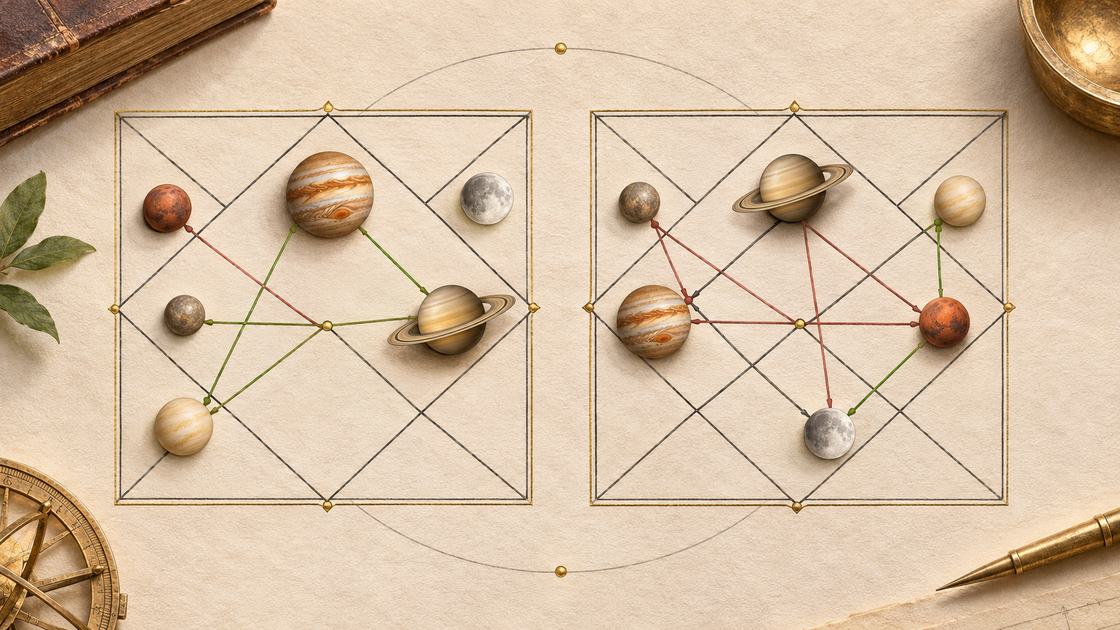
Traditional classifications need interpretation
Jyotiṣa does distinguish between combinations associated with support and those associated with difficulty. We do not need to discard those distinctions to recognize their limitations.
The task is to understand what a classification means within the system and how it applies to the chart being examined.
Assessment includes the participating planets, their condition, their house rulerships, and the influences they receive. A combination’s capacity to produce its traditional indications therefore requires examination beyond its name.
If you are new to the subject, our introduction to yogas and planetary combinations provides a foundation for understanding this process.
“Favorable” does not mean favorable in every respect
Consider a description that associates a yoga with achievement.
It is easy to read this as a promise that work will be rewarding, advancement straightforward, and recognition satisfying. Yet these are separate claims.
A person can achieve something significant through years of demanding effort. They can be respected professionally while feeling uncertain about their direction. They can gain responsibility without gaining the freedom they hoped would accompany it.
These examples illustrate why an interpretation needs a clearly defined subject.
Before accepting a broad statement about success, we need to ask what kind of success is being described and what supports that reading.
A favorable indication concerning one area of life also tells us little, by itself, about every other area. Professional recognition does not establish the condition of someone’s relationships, health, or private happiness.
“Difficult” is not a judgment about the person
A troubling chart description can easily become personal.
Someone reads about a difficult yoga and begins to think, “There is something wrong with my chart,” or even, “There is something wrong with me.”
This is an unhelpful step.
An astrological classification is not a judgment of character, worth, or deservingness. Nor does hardship become more understandable simply because we attach a Sanskrit name to it.
I encourage an approach that keeps the person in view. If a reading identifies a possible challenge, the explanation needs to be specific, proportionate, and attentive to the broader circumstances.
There is no educational value in leaving someone frightened by a label they do not understand.
Supporting and challenging indications can coexist
A chart may contain indications that appear to pull in different directions.
As explored in Can a Birth Chart Show Conflicting Patterns?, support and difficulty can concern different aspects of the same subject. Ability, opportunity, and ease do not always arrive together.
This means we cannot read a chart by placing its yogas into two columns and counting which side wins.
Five favorable labels and three unfavorable labels do not produce a meaningful overall score. The combinations may differ in strength, relevance, subject, and timing. Some may also involve overlapping factors.
Interpretation requires understanding those relationships.
Hart deFouw emphasizes this movement between the individual chart factor and the whole chart: each contributes to understanding the other. A placement’s meaning develops through its context.
Dramatic wording can obscure the actual claim
An online description may use sweeping phrases such as “destined for greatness,” “certain wealth,” or “lifelong struggle.”
Before applying such a statement to yourself, pause and examine it.
What would count as greatness? How much wealth, acquired in what way, and at what stage of life? What kind of struggle is being proposed?
If the wording cannot be made more specific, it may offer little that can be assessed.
Clear language is particularly important when presenting traditional descriptions to contemporary readers. A striking phrase may attract attention while leaving the underlying interpretation unexplained.
The useful question is whether the writer shows how they reached their conclusion.
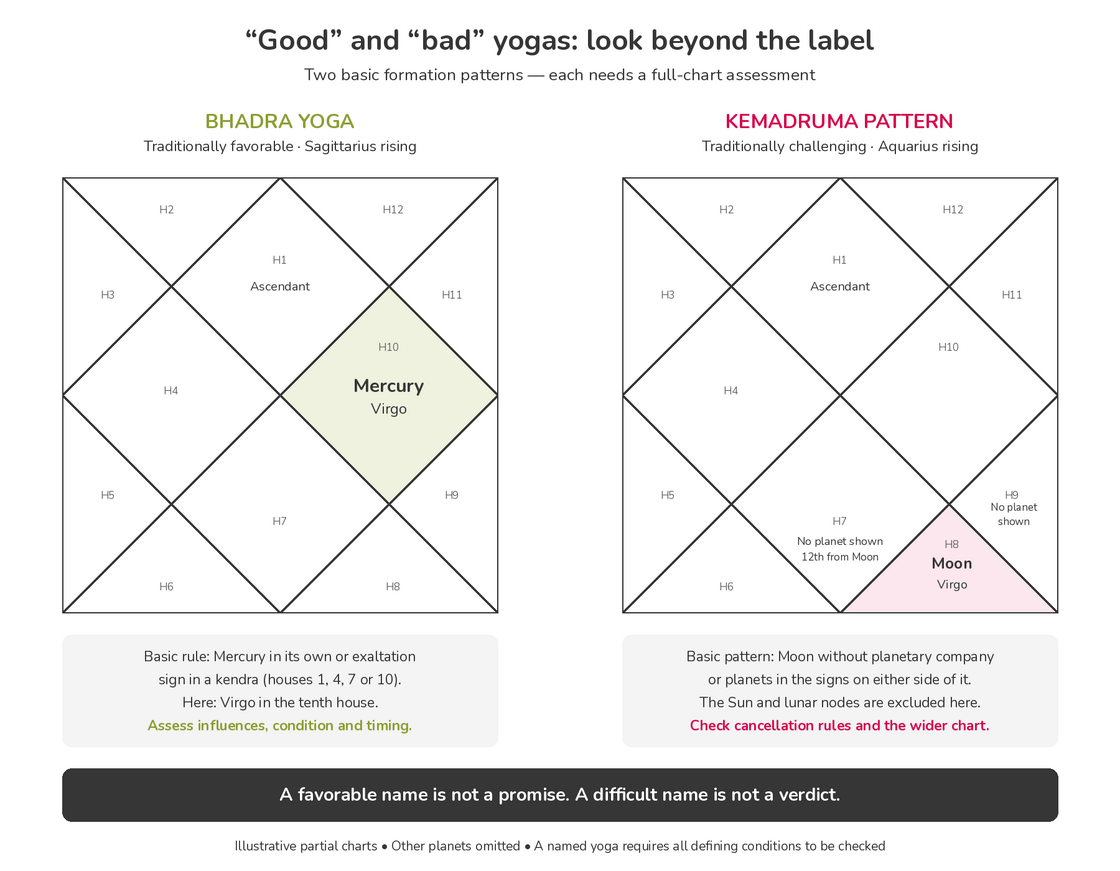
A more thoughtful way to read an online yoga description
You do not need advanced knowledge to ask better questions about what you read.
1. Look for the actual definition
Does the article explain the conditions required for the yoga?
A name and a list of promised results provide little basis for checking whether the combination has been identified correctly. Look for a clear explanation of the factors involved and the source or teaching approach being followed.
2. Separate the combination from the prediction
“This arrangement is present” and “this event will happen” are different statements.
Our article Does Having a Yoga in Your Birth Chart Guarantee a Particular Outcome? examines this distinction in more detail.
A useful description explains the steps between identifying a pattern and interpreting its possible significance.
3. Check what qualifications are included
Does the writer discuss circumstances that strengthen, modify, or limit the interpretation?
Planetary condition, rulership, the wider chart, and relevant planetary periods form part of qualifying yogas within traditional analysis. A description that omits these considerations is necessarily incomplete.
4. Notice the scope of the conclusion
Does a statement about one combination become a claim about the person’s entire life?
Be cautious when a narrow observation expands into a universal description without further explanation. The conclusion needs to remain proportionate to the information being considered.
5. Allow room for uncertainty
A responsible explanation can distinguish between what has been identified, what is being inferred, and what remains unclear.
Uncertainty gives us something to investigate. Concealing it behind confident language makes learning more difficult.
Use lists as study prompts
A list of yogas can help you identify terms to explore. It can introduce combinations you have not encountered before and raise questions for a teacher.
Its usefulness increases when you treat it as the beginning of an inquiry.
For example, instead of collecting favorable yogas as reassurance, choose one combination and study its definition carefully. Examine how it is assessed in several charts. Notice which details change the interpretation.
If a description concerns you, bring the specific claim to someone qualified to explain its basis and limitations.
The aim is to develop understanding that is detailed enough to be useful and careful enough to respect the person whose chart is being read.
Learn to assess yogas in context
Our Jyotiṣa Foundations Program develops chart interpretation through four sequential levels, beginning with the planets, signs, and houses.
In Level 3, students work with yogas and the texts that describe them, learning to assess combinations within the wider chart. Guided practice and interpretive mentorship sessions called Digestions provide opportunities to question initial conclusions and develop greater discernment.
Learn more about the Jyotiṣa Foundations Program.
If an online description has raised questions about your own chart, I also offer private consultations. We can consider those questions within a fuller reading rather than leaving you with an isolated label.

Comments