

Modern psychology has given us many valuable tools for understanding the human mind. It has helped us explore trauma, attachment, emotional regulation, behavioural conditioning, cognition, and the hidden dynamics of the unconscious. Yet for many people, something still feels incomplete.
We may understand why we suffer, yet still remain trapped within the same patterns.
We may analyse our anxiety endlessly, yet still feel disconnected from ourselves.
We may intellectually recognise our conditioning, while the nervous system and deeper psyche continue to repeat old loops.
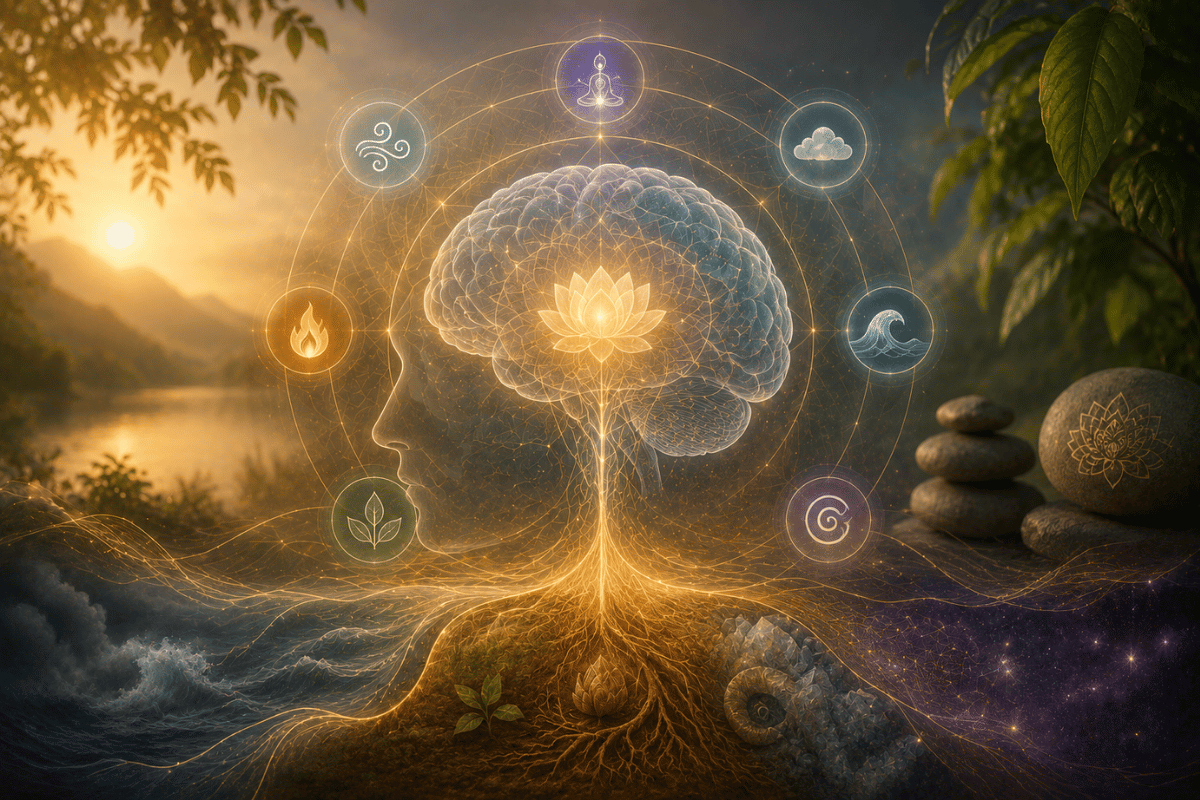
Yoga-informed psychotherapy begins from a different premise. It understands that the mind is not merely cognitive. Human beings are energetic, psychological, emotional, symbolic, and spiritual. The psyche is layered, subtle, and deeply interconnected with the body, breath, nervous system, and consciousness itself. Healing therefore cannot occur only through intellectual insight. It requires work at deeper levels of the being.
Within the yogic traditions, the purpose of practice has always been the reduction of suffering and the awakening of greater self-awareness, stability, clarity, and freedom. Long before modern psychotherapy existed, yoga psychology explored the causes of mental disturbance, emotional imbalance, trauma, identity, unconscious conditioning, and human transformation.
What we now call “yoga-informed psychotherapy” is, in many ways, the meeting place between modern psychology and the ancient science of consciousness developed within yoga and tantra.
What Is Yoga-Informed Psychotherapy?
Yoga-informed psychotherapy integrates the insights of modern psychological practice with the experiential methods of yoga psychology and meditation.
This approach recognises that many psychological difficulties are not only “mental” problems. They are also disturbances in the flow of energy, awareness, nervous system regulation, unconscious conditioning, and identity.
In yogic psychology, much of our suffering arises because awareness becomes trapped in repetitive patterns. These patterns are known as samskaras — deeply conditioned impressions stored within the psyche that shape perception, emotion, behaviour, and identity.
These unconscious patterns may arise through trauma, family conditioning, cultural expectations, unresolved emotional experiences, or habitual thought loops. Over time they create rigidity in both mind and body. The nervous system becomes conditioned toward anxiety, fear, compulsive thinking, emotional reactivity, exhaustion, or disconnection.
Yoga-informed psychotherapy works not only through discussion and insight, but through practices that help regulate and reorganise the whole system.
This may include:
- breath practices (prānāyāma)
- meditation
- mantra
- body awareness
- nervous system regulation
- concentration practices
- symbolic and archetypal work
- self-observation
- contemplative inquiry
- lifestyle alignment
- shadow integration
- yogic philosophy as a framework for understanding consciousness
Rather than merely suppressing symptoms, the aim is to restore greater balance, awareness, resilience, and connection to the deeper Self.
The Yogic View of the Mind
One of the great contributions of yoga psychology is its remarkably sophisticated understanding of the mind.
In the yogic model, the mind is not a single structure. It contains multiple layers and functions. The deeper psyche includes unconscious tendencies, instinctual drives, memory patterns, symbolic imagery, emotional residue, and latent potentials.
Yoga psychology also recognises that the body, breath, mind, emotions, and consciousness constantly influence one another. This is why anxiety may appear simultaneously as:
- racing thoughts
- muscular tension
- shallow breathing
- digestive disturbance
- emotional overwhelm
- exhaustion
- hypervigilance
- inability to rest
The system operates as an interconnected whole.
From this perspective, healing requires more than cognitive reframing alone. The deeper layers of the psyche and nervous system must also be addressed.
Beyond Symptom Management
One of the limitations of modern culture is that we often approach mental health purely through symptom reduction.
We ask:
- How do I stop anxiety?
- How do I stop overthinking?
- How do I feel better quickly?
While relief is important, yoga psychology asks a deeper question: What is the suffering trying to reveal?
Many symptoms are actually signals emerging from deeper levels of the psyche.
Anxiety may reflect unresolved fear, energetic overload, suppressed emotion, chronic hypervigilance, or disconnection from grounding and embodiment.
Depression may involve exhaustion, emotional collapse, loss of meaning, unresolved grief, or psychic withdrawal.
Compulsive thinking often reflects a mind unable to settle because deeper tensions remain unresolved.
Yoga-informed psychotherapy does not romanticise suffering, nor does it encourage endless analysis. Instead, it aims to create enough inner steadiness and awareness for unconscious material to gradually emerge, integrate, and reorganise. Meditation, mantra, breathwork, and self-observation become tools for working directly with these deeper layers of the mind.
The Role of the Nervous System
A major strength of yoga-informed approaches is their ability to regulate the nervous system directly.
Modern life continuously overstimulates attention and keeps many people locked in chronic sympathetic activation — always alert, rushing, reacting, consuming, scrolling, and thinking. The nervous system rarely settles deeply enough for true repair. Yogic practices were designed specifically to calm this agitation.
Breath regulation, mantra repetition, meditation, and body awareness help shift the system toward parasympathetic regulation. Over time this reduces mental turbulence and increases resilience, emotional steadiness, concentration, and clarity. This is one reason mantra and meditation practices can have such profound psychological effects. They work not only through insight, but through rhythm, vibration, repetition, breath, and nervous system entrainment.
Mantra as a Psychological Tool
One of the most misunderstood aspects of yoga psychology is mantra. Many people mistakenly view mantra as religious chanting or positive affirmations. In the yogic traditions, mantra is understood much more deeply. Mantras are vibrational tools that influence consciousness, attention, emotional states, and the deeper layers of the psyche. The repetition of a mantra helps interrupt compulsive thought patterns while gradually reorganising the inner landscape of the mind. Through sustained practice, old psychological loops begin to loosen and the nervous system becomes more stable and coherent.
In yoga-informed psychotherapy, mantra may be used to:
- calm anxiety
- stabilise attention
- reduce mental agitation
- support emotional regulation
- create positive inner orientation
- strengthen resilience
- cultivate clarity and groundedness
- support trauma integration
- deepen meditative awareness
Importantly, mantra works beyond the intellectual mind. It engages deeper symbolic and vibrational levels of the psyche. This is one reason many practitioners experience profound shifts that cannot always be explained purely cognitively.
Shadow Work and the Unconscious
Yoga psychology also recognises that growth requires confronting hidden aspects of ourselves. Much of human behaviour is driven by unconscious material operating beneath awareness. Jungian psychology called this the shadow. Yogic traditions explored the same territory through meditation, self-study, and inner observation long before modern psychology developed similar language.
When ignored, these unconscious forces influence behaviour from behind the scenes. They may appear as:
- emotional reactivity
- projection
- self-sabotage
- compulsions
- avoidance
- rigid identities
- destructive relational patterns
- fear
- shame
- internal conflict
Yoga-informed psychotherapy encourages a gradual and compassionate process of becoming aware of these hidden dynamics. This is not about self-judgement. It is about integration.
As awareness deepens, the individual becomes less driven by unconscious conditioning and more capable of conscious response. Meditation plays a central role here because silence gradually reveals what distraction conceals.
Applying Yoga Psychology in Everyday Life
Yoga-informed psychotherapy is not confined to the meditation cushion or therapy room. Its aim is practical integration into daily life.
This may include:
- Developing Self-Observation: Learning to witness thoughts, emotions, and reactions without becoming completely identified with them.
- Regulating the Nervous System: Using breath, meditation, grounding practices, and lifestyle rhythms to create stability.
- Working with the Body: Recognising how psychological stress is stored physically through tension, posture, fatigue, and breath restriction.
- Cultivating Sattwa: In yoga psychology, sattwa refers to clarity, balance, steadiness, and luminosity of mind. Practices, environments, relationships, food, sleep, and habits all influence mental states.
- Interrupting Old Patterns: Bringing awareness to repetitive loops and consciously introducing healthier rhythms and responses.
- Developing Inner Stillness: Creating enough quiet for deeper intuition, insight, and self-understanding to emerge naturally.
- Aligning Life with Practice: Healing is strengthened when meditation and self-awareness are supported by daily living that reduces excess overstimulation, chaos, and fragmentation.
A More Complete Model of Healing
Yoga-informed psychotherapy offers something many people are searching for: a model of healing that includes the whole human being. It acknowledges biology and psychology, while also recognising meaning, consciousness, symbolism, energy, archetype, and spiritual development. It does not ask people to adopt a belief system. Rather, it offers practical methods for increasing awareness and reducing suffering.
For some, this path begins with stress reduction.
For others, it begins with trauma healing or emotional regulation.
For others still, it becomes a deeper journey into consciousness itself.
The aim is integration, clarity, steadiness, and freedom from unconscious bondage.

Further Learning with Big Shakti
For those wanting to explore these teachings more deeply, Big Shakti offers several trainings and courses integrating yoga psychology, meditation, mantra, and therapeutic application.
Yoga Psychology & Psychotherapy Course
A comprehensive exploration of yogic models of the mind, meditation, psychological healing, and the integration of Eastern and Western approaches to mental wellbeing.
Yoga Psychology Course Bundle
An in-depth learning pathway covering yoga psychology, healing the mind, shadow work, and therapeutic meditation practices.
Yoga Therapy Bundle
A collection of practices and teachings designed to support nervous system regulation, emotional wellbeing, meditation, and inner balance.
Yoga of Mental Health Workshops
Workshops exploring yoga psychology, mental health, emotional regulation, trauma, self-awareness, and therapeutic yogic practices.
The Mantra Yoga Training Pathway
Big Shakti’s Foundations, Intermediate, and Advanced Mantra Yoga courses explore mantra as a tool for psychological integration, energetic balance, concentration, and expanded states of consciousness.
These trainings examine mantra not merely as philosophy, but as a practical science of sound, attention, and inner transformation.
- Light on Mantra Yoga ~ Foundations Course
- Light on Mantra Yoga ~ Intermediate Course
- Light on Mantra Yoga ~ Advanced Course
A final note on yoga-informed Psychotherapy
Yoga-informed psychotherapy reminds us that healing is not simply the removal of symptoms. It is the gradual restoration of wholeness.
When awareness deepens, when the nervous system settles, when unconscious patterns begin to loosen, and when the fragmented parts of the psyche are gently brought into relationship with one another, something profound begins to occur.
The mind becomes quieter.
The inner life becomes more coherent.
And beneath the turbulence, we begin to rediscover a deeper ground of being that was never truly lost.
Om
Swami Shankardev & Jayne Stevenson
More info: 1:1 Yoga Psychotherapy Consultations

Comments