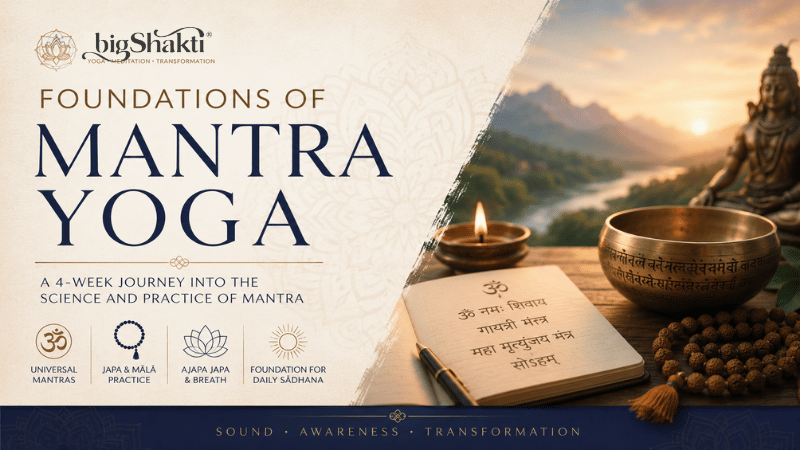
Foundations of Mantra Yoga
A 4-Week Online Course in the Psychology and Practice of Sacred Sound
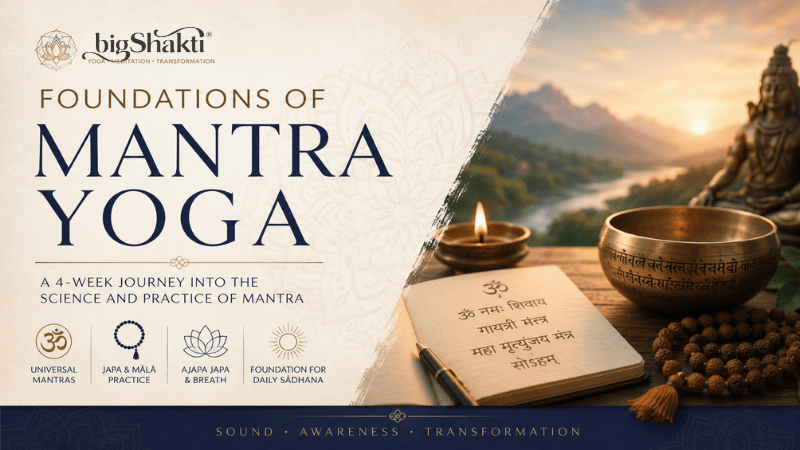
A 4-week course designed to help you enter the transformative practice of mantra yoga with clarity and understanding, while also giving you direct experience of mantra as a living force within the body, breath, and mind.
🧘 Teacher: Dr Swami Shankardev Saraswati
🖥️ 4 online modules covering the foundations of Mantra Yoga
📽️ Video Teachings and Q&A from recorded Workshops
🧘🏻♀️ Meditation Audios (listen online or download)
🗂️ Practices to Integrate
📨 Email support from Teachers
No prior experience with mantra, Sanskrit, or meditation is required.
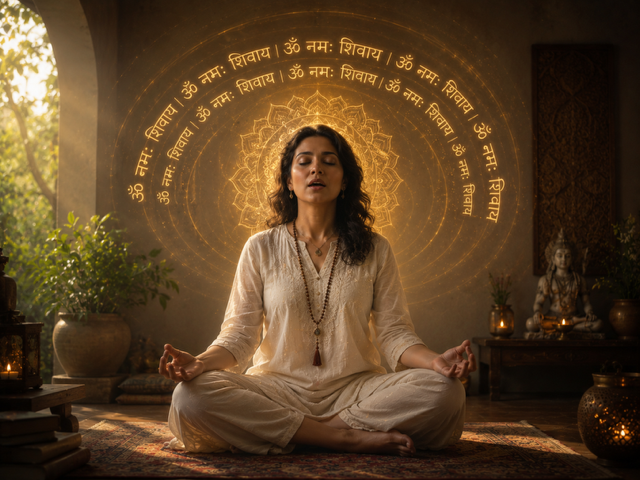
Most people repeat mantras without ever being taught how mantras actually work.
They chant mechanically.
Their minds wander.
They may feel temporarily calmer, yet the deeper transformation promised by the yogic tradition never truly begins.
This course was created to change that.
Over four weeks, you will learn how mantra works within the structure of the mind itself, and how sacred sound can gradually calm emotional turbulence, restore inner order, deepen awareness, and open the doorway to the deeper dimensions of mantra yoga.
Grounded in the classical traditions of yoga, tantra, and mantra shāstra, this training combines ancient wisdom with a psychologically informed understanding of the human mind, giving you a systematic and deeply practical foundation for authentic mantra practice.
The Core Framework: Two Levels of Mind
One of the central teachings of this course is that the mind operates on two interconnected levels.
The Surface Mind – The active thinking, emotional, and sensory mind responsible for daily functioning, reactions, identity, and mental activity. This is the level of mind where we chant a mantra.
The Deep Mind – The deeper layer of the psyche associated with intuition, memory, karmic patterning, emotional residues, and deeper consciousness. Mantras are continually vibrating at this level.
The Barrier – Between these two levels exists a natural psychological barrier.
When the surface mind is restless, emotionally overloaded, distracted, or internally chaotic, the mantra remains trapped at the surface level and practice becomes mechanical.
But when sufficient awareness, relaxation, steadiness, and witness consciousness are developed, mantras gradually begin to penetrate more deeply, which initiates profound inner change.
This Foundation Course is designed specifically to build those conditions.
What You Will Learn
Module 1 — What Is Mantra?
Begin with the foundations of mantra yoga and explore what a mantra actually is, where this ancient practice comes from, and its place within the wider yogic and tantric tradition.
In this module, you will learn:
-
What a mantra is — moving beyond the idea of mantra as simply a word or phrase to understand it as sacred sound and vibration used to influence energy, mind and consciousness.
-
Śiva and Śakti — the relationship between consciousness and energy at the heart of Tantra, and how mantra practice works with these two fundamental principles.
-
The universal roots of mantra — exploring sacred sound as a human phenomenon found across cultures and traditions, while understanding why India developed and preserved such a sophisticated science of mantra.
-
The origins and development of mantra — including the Vedic, Upanishadic, yogic and tantric streams from which contemporary mantra practice has emerged.
-
The place of Mantra Yoga within the yogic path — and its role as a bridge between the more physical practices of Hatha Yoga and the subtler practices of Laya and Raja Yoga.
-
Mantra Yoga sadhana — beginning to understand mantra not simply as something to chant, but as a sustained personal practice through which a relationship with sacred sound develops.
-
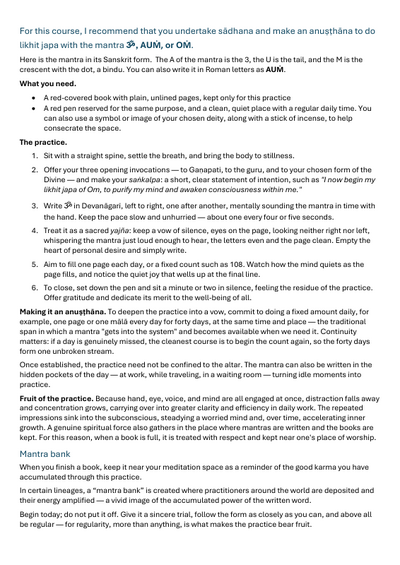
The practice of likhita japa — learning written repetition of Oṁ as another way of concentrating the mind and engaging deeply with the mantra.
-
Meditation with mantra — beginning the experiential work of listening to, feeling and internalising mantra through guided meditation.
Module 2 — Mūla & Gāyatrī Mantras
Build on the foundations of mantra yoga by exploring how different mantras work within the mind and psyche, how they are classified, and how to begin choosing and practising a mantra with greater clarity and purpose.
In this module, you will learn:
-
The evolution of mantra through the Vedic, Upanishadic, yogic and tantric traditions — and how mantra developed from sacred sound and ritual into a sophisticated practice for working with consciousness, the psyche and subtle energy.
-
The place of Mantra Yoga within the wider yogic path — including its relationship with Hatha Yoga and the more advanced practices of Laya, Raja and Kundalini Yoga.
-
Sāṃkhya and Vedānta as maps of the mind — including manas, buddhi, ahamkara and chitta, and how mantra works across the different layers of mind, psyche and consciousness.
-
Chitta shuddhi — purification of the psyche — understanding how mantra can bring unconscious patterns and samskaras into awareness while strengthening the relationship between the conscious mind and deeper intuitive intelligence.
-
The koshas and levels of mantra practice — exploring how audible and mental mantra can move from the physical and thinking mind towards subtler levels of awareness.
-
How mantras are classified — by origin, structure, deity, purpose, number of syllables and energetic quality, helping you understand why different mantras are used for different aims.
-
The three mahā gunas — sattva, rajas and tamas — and how intention influences the way a mantra is used, whether for clarity and spiritual development, worldly aims or more forceful purposes.
-
Mūla mantras — root mantras associated with specific devatās or psychospiritual archetypes, and how they develop concentration, influence prāṇa and cultivate particular inner qualities.
-
Gāyatrī mantras — their traditional 24-syllable structure, their relationship with buddhi or higher intelligence, and their role in preparing and illuminating the mind.
-
How Mūla and Gāyatrī mantras work together — with the Gāyatrī helping to purify and clarify the mind while the Mūla mantra invokes the qualities and energy of a specific devatā.
-
Choosing a mantra for personal practice — including why beginners are guided towards simple forms without bīja syllables, and the importance of working steadily with one primary mantra rather than continually changing practices.
-
The role of sankalpa, feeling and one-pointed intention — using the image of the bow, arrow and target to understand how mantra śakti is consciously directed towards a clear purpose.
-
Developing a personal mantra sadhana — including japa, use of a mālā, regular practice, anuṣṭhāna and adapting the practice realistically to your body, life and level of experience.
-
Guided mantra meditation using Oṁ Namaḥ Śivāya and the Gaṇeśa Mūla Mantra, with attention to stillness, breath, Ajna Chakra, the individual syllables of the mantra and the felt experience of its vibration.
-
Practical guidance covering initiation, bīja mantras, pronunciation, mālā practice, choosing one mantra, building practice gradually and integrating mantra into everyday life.
Module 3 — Sound and Symbol, Mantra and Devatā
This module goes deeper into the nature of sacred sound, exploring how mantra differs from ordinary language, how sound operates through different levels of consciousness, and why mantra and symbol are used together to connect the practitioner with deeper dimensions of the psyche.
In this module, you will learn:
-
The difference between ordinary words and mantras — how everyday language helps construct the conditioned mind and ego, while mantra points beyond ordinary naming and conceptual thought towards subtler levels of experience.
-
How language shapes perception and identity — including the relationship between manas, buddhi and chitta, and why mantra practice helps loosen over-identification with the rational, thinking mind.
-
Mātrikās — the sound-mothers of Sanskrit — exploring the Sanskrit letters as fundamental units of sacred sound, each carrying its own vibrational quality and traditionally associated with the chakras and subtle body.
-
The relationship between sound and symbol — and how mantra and yantra can be used together to bring concentration, feeling, intuitive awareness and symbolic meaning into a single practice.
-
The intuitive power of sound — including how different vowels, consonants and resonances can be experienced directly rather than understood only through intellectual meaning.
-
The hidden structure within mantras — how sacred texts and longer mantras may contain subtler mantra forms, bīja sounds and layers of meaning that are revealed through sustained practice and, in some traditions, initiation.
-
The four levels of sound — Vaikharī, Madhyamā, Paśyantī and Parā — tracing sound from audible speech and inner thought back towards its subtle, pre-verbal and transcendent source.
-
The deeper meaning of Oṁ and So Haṁ — including bindu, the silence beyond sound, the relationship between sound and consciousness, and why these apparently simple mantras carry such depth within the yogic tradition.
-
Mantra Chaitanya — when mantra becomes alive in practice — understanding the progression from repeating a sequence of syllables to experiencing mantra as a living presence that begins to arise with less effort.
-
Signs of deepening mantra practice — including spontaneous repetition, greater inner stillness, stronger intuition, reduced identification with the ego, purification of samskaras and a growing felt relationship with the mantra.
-
Devatā as psychospiritual archetype — exploring devatās as powerful symbolic and psychic forces within both the individual and the wider world, rather than simply external religious figures.
-
The relationship between mantra and devatā — how the mantra provides the sound-form of the devatā and how sustained practice can deepen the practitioner's relationship with the qualities and consciousness it represents.
-
An introduction to the Daśa Mahāvidyā — the ten great wisdom goddesses and the wide spectrum of psychological and spiritual forces they symbolise, from fierce destruction and dissolution through to beauty, abundance and grace.
-
The role of intention, sankalpa and preparation — why mantra practice requires a clear purpose, steadiness and enough psychological grounding to work safely with deeper psychic material.
-
The three Tattvatraya mantras — Oṁ Ātma Tattvāya Svāhā, Oṁ Vidyā Tattvāya Svāhā and Oṁ Śiva Tattvāya Svāhā — used to orient awareness from individual consciousness towards knowledge and higher consciousness.
-
Guided meditation with Oṁ Namaḥ Śivāya and So Haṁ — combining grounding, breath, mudrā, mantra, the heart centre and the frontal psychic passage to cultivate stability, reconnect with feeling and deepen awareness of mantra as lived experience.
-
Practical guidance covering pronunciation, bīja mantras, japa, likhita japa, mantra with music, concentration, mudrā and how to bring mantra practice into daily life.
Module 4 — Building Your Sādhana
Bring the teachings together into a practical framework for ongoing mantra practice, with a deeper look at karma, psychological healing, archetypal forces and how to build a sādhana that can support you over time.
In this module, you will explore:
-
Mantra Yoga as a therapeutic practice — how mantra can calm and stabilise the thinking and emotional mind, support self-regulation, and gradually work at deeper levels of the psyche when practised consistently.
-
Working with the psyche safely — including the importance of grounding, witness consciousness and one-pointed awareness when difficult emotions, memories or unconscious material begin to surface.
-
Mantra and psychological healing — how mantra can be combined with psychoeducation, meditation, breath practices and therapeutic work to help bring old patterns into awareness without becoming overwhelmed by them.
-
Carl Jung and the archetypes — exploring Jung’s understanding of archetypes as living psychic forces that influence thoughts, emotions, behaviour and life transitions, whether we recognise them consciously or not.
-
The relationship between devatā and archetype — and how Eastern and Western symbolic systems can both provide meaningful ways of relating to deeper aspects of the psyche.
-
The journey from ego to Self — why a stable, healthy ego is essential before working more deeply with powerful archetypal material, and how mantra can gradually support the movement from a contracted sense of self towards a wider awareness.
-
The risks of ego inflation and deflation — understanding how powerful inner experiences can be mistaken for personal power, and why humility, discernment and self-awareness remain central to deeper practice.
-
What karma is and how it operates — exploring karma as action and consequence, the samskaras created through experience, and how past and present actions shape future possibilities.
-
The four forms of karma — Sanchita, Prārabdha, Kriyamāṇa and Āgāmi — and how each describes a different stage in the movement from accumulated karma to present action and future consequence.
-
Fixed and changeable karma — distinguishing between patterns that may change relatively easily, those that require sustained work, and those that cannot necessarily be removed but whose impact and meaning can be approached differently.
-
Can mantra change karma? — examining where mantra can help weaken old psychological patterns, create new sattvic samskaras and strengthen our ability to meet unavoidable circumstances with greater awareness and agency.
-
Creating new karma through practice — understanding every intentional mantra practice as an opportunity to reinforce new ways of perceiving, thinking and responding rather than continually feeding older patterns.
-
Jyotish and Mantra Yoga — an introduction to Indian astrology as a traditional method for understanding Prārabdha karma and identifying the planetary forces or grahas associated with particular strengths and challenges.
-
Planetary archetypes and mantras — exploring the symbolic qualities associated with the Sun, Moon, Mars, Mercury, Jupiter, Venus, Saturn, Rahu and Ketu, and how planetary mantras may be used within a personalised practice.
-
Why mantra selection matters — including the difference between the universal mantras taught in this foundational course and more specialised practices that may require individual guidance or initiation.
-
Building your personal mantra practice — how to work with one primary mantra, determine a realistic number of repetitions, and develop a rhythm of practice that can remain part of your life rather than becoming another short-lived project.
-
Japa with a mālā — understanding the mālā as both a counting tool and a grounding element within practice, including why the meru bead is not crossed at the end of each round.
-
Ajapa Japa as an ongoing practice — combining mantra, breath, awareness and the chakra pathways to integrate body, mind and psyche while remaining grounded and self-aware.
-
Anuṣṭhāna — periods of dedicated practice — exploring how to undertake more focused mantra practice over a set period, while adapting the commitment to your capacity, circumstances and purpose.
-
The role of sankalpa in sādhana — clarifying what the practice is being directed towards so that mantra śakti is connected to a meaningful and consciously chosen intention.
-
Guided Ajapa Japa meditation — working with Oṁ and So Haṁ through the breath, spinal passage, chakras and witness awareness as a practical way to bring together the central teachings of the course.
-
Practical guidance on choosing a mantra, Durga and protection practices, mantra with yantra, days of practice, anuṣṭhāna, guru mantra, Jyotish, mudrās and how to continue after the course.
What This Course Can Begin to Cultivate
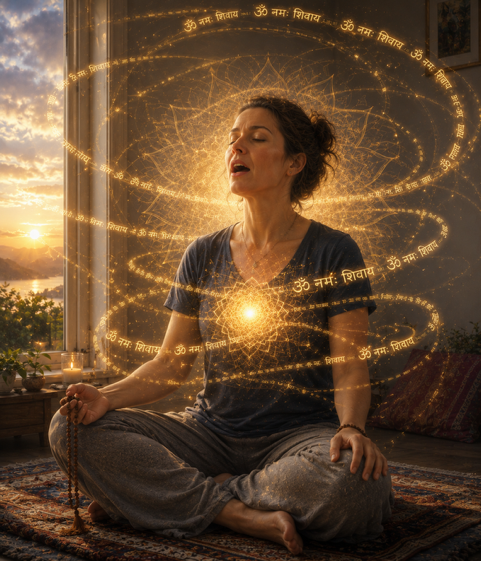
With sincere and sustained practice, many practitioners begin to experience:
- Healing of the mental and emotional blockages that prevent progress
- Greater emotional steadiness
- Improved concentration and clarity
- Reduced mental overactivity
- Deeper self-awareness
- Increased inner resilience
- A quieter nervous system
- A stronger daily practice
- A deeper relationship with meditation
- Access to subtler dimensions of inner experience
Rather than remaining caught in constant mental noise, practitioners gradually begin to experience a deeper layer of stillness beneath the mind's surface activity.
Who This Course Is Ideal For
- Beginners wanting a genuine foundation in mantra yoga
- Meditators whose practice has plateaued
- Yoga practitioners wanting to move beyond āsana
- Therapists and healing practitioners interested in mantra-based approaches
- Spiritually oriented people seeking grounded, systematic training
- Experienced practitioners wanting greater depth and clarity
- Anyone drawn to the transformative potential of sacred sound
No prior experience with mantra, Sanskrit, or meditation is required.
About the Teacher
Dr. Swami Shankardev Saraswati is an internationally respected teacher of yoga, meditation, mantra, and yoga psychology with decades of teaching experience integrating the classical yogic traditions with modern psychological understanding.
His teaching combines:
- Mantra yoga
- Tantra
- Meditation
- Yoga psychology
- Subtle body theory
- Depth psychology
- Practical lived application
The emphasis throughout the course is not merely on intellectual understanding, but on direct inner experience and sustainable transformation through practice.
Course Details
Level: Stage 1 ~ Foundation
No prior experience with mantra, Sanskrit, or meditation is required.
Teacher: Dr Swami Shankardev Saraswati
On-demand Course: Recordings & Resources Provided
CPE Hours: 10
Registration: USD$149 or 3 instalments of $50
A Progressive Journey Into Deeper Practice
This course is the first stage in a larger progression of mantra yoga training.
Stage 1: Foundations — Stabilizing the surface mind and establishing correct practice. We cannot progress to the deeper, more satisfying levels of practice if we are caught up in overthinking, anxiety, or emotional overwhelm.
Stage 2: Intermediate — Allowing mantra to penetrate into the deeper psyche and working with deeper transformative processes, including tantric and astrological remedial approaches. 🔗 LEARN MORE
Stage 3: Advanced — Working with yantra, chakras, subtle body practices, and the therapeutic application of mantra for deep karmic and psychological transformation. 🔗 LEARN MORE
Content
Foundations of Mantra Yoga
Introduction
Module 1 ~ What Is Mantra?
Module 2 ~ Mūla & Gāyatrī Mantras
Module 3 ~ Sound and Symbol, Mantra and Devatā
Module 4 ~ Building Your Sādhana

Course Completion
I had so many positive shifts in the right direction on so many levels of my life just making the sankalpa to re-establish a regular meditation practise through the resumption of my yoga studies formally with you.
I knew for a long time that Mantra would be the key to helping me establish consistency. I knew it was the missing link but was struggling in the mire of daily life, obligations etc., Therefore it was so reassuring that just making the intention to do the course that I could observe that things were starting to shift.
A final note to share is the tremendous feeling of physical AND mental ease that I felt during the teachings on Monday. I haven’t felt that in a long, long time. Thank you.