

A single planetary placement gives you something to explore. When several relevant factors point toward a similar subject, that subject deserves closer attention.
Perhaps learning appears connected with work in more than one part of a chart. Or several relationships between grahas and houses draw attention to home and family.
In Jyotiṣa, commonly known as Vedic astrology, this coming together of indications is often described as confluence.
Recognizing confluence helps an astrologer move from separate observations toward a coherent interpretation. The skill involves understanding how the factors relate, how much weight they carry, and what might qualify the emerging picture.
What does confluence mean?
Confluence means that several relevant chart factors support a similar theme.
These factors might include a graha’s natural significations, its house placement, the houses it rules, and its relationships with other grahas.
For example, Mercury’s association with speech provides one point of reference. A connection between Mercury and houses relevant to communication or work adds context. Further supporting indications may give the astrologer more reason to investigate that relationship.
Chart interpretation brings these different layers together rather than treating each placement as a separate statement.
A useful distinction is between noticing a possibility and finding a pattern:
“This placement suggests a subject worth exploring.”
“Several factors make this subject relevant to the reading.”
The second observation has more support, although it still needs careful assessment.
What counts as a repeated theme?
A theme can appear through different kinds of chart relationships.
| Chart factor | What it contributes |
|---|---|
| A graha’s natural meanings | Subjects traditionally associated with that graha |
| House placement | An area of life in which those meanings are considered |
| House rulership | Other areas of life connected through the graha |
| Conjunctions and aspects | Relationships that may support or complicate the interpretation |
The repetition does not have to involve the same graha appearing several times in your notes. Different factors may converge on a related subject.
House rulership is particularly important here. A graha carries the responsibilities of the houses it rules, alongside its natural meanings. Its role therefore depends on the individual chart.
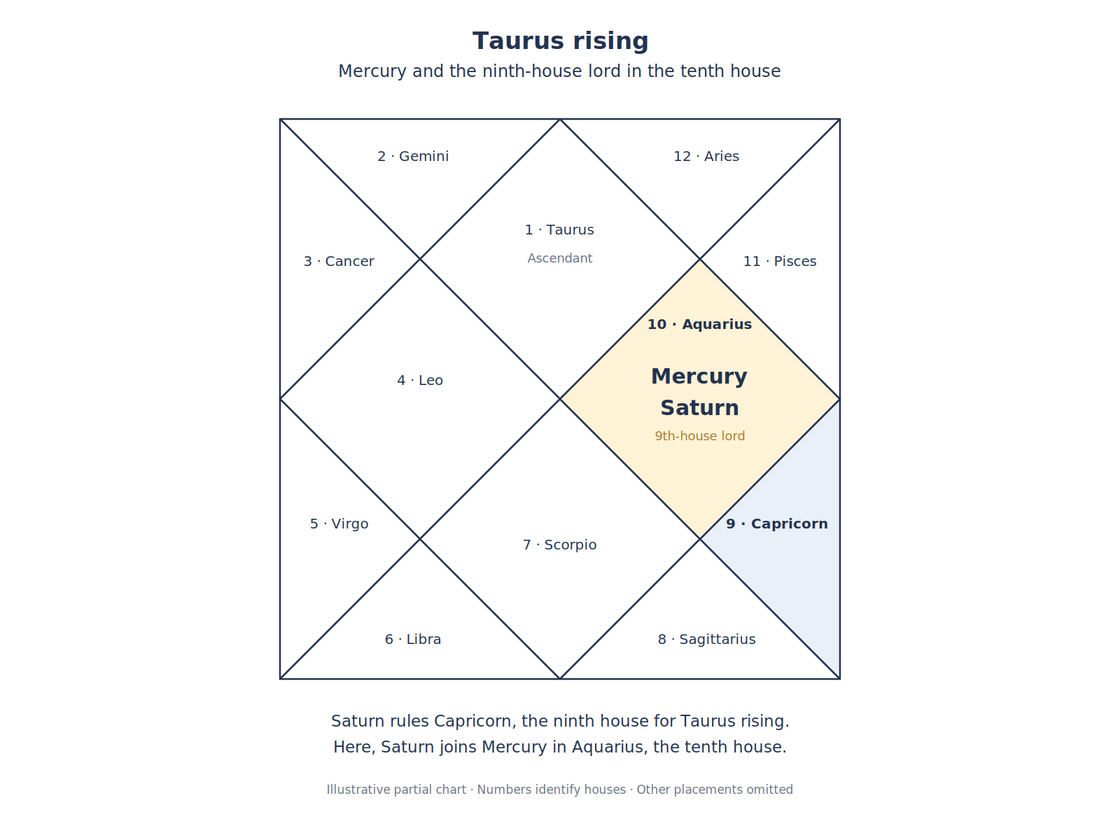
An introductory example: Learning and work
Consider a simplified, hypothetical chart in which:
-
Mercury occupies the tenth house.
-
The ninth-house lord also occupies the tenth house.
Mercury has traditional associations with learning and communication. The ninth house includes teachers and higher learning, while the tenth concerns work and public activity.
These associations provide the basis for the example.
The two observations give us different reasons to examine a connection between knowledge and working life:
| Observation | Initial question |
|---|---|
| Mercury occupies the tenth house | How might communication or learning participate in work? |
| The ninth-house lord occupies the tenth house | How might higher learning, teachers, or guiding principles connect with professional activity? |
Together, they suggest that learning and work may be meaningfully related.
That relationship could take several forms: teaching, advising, writing, undertaking specialist training, or working in a field where knowledge is central. These are illustrative possibilities, rather than conclusions established by the two placements.
To become more specific, we would need to examine the grahas’ condition, other influences, and the wider chart.
The point is the reasoning: two relevant observations support a shared line of inquiry.
Repetition is different from restating one observation
It is easy to make a theme look stronger by describing the same factor in several ways.
Suppose Mercury occupies the tenth house. You write:
- Communication may be relevant to work.
- Speech may be relevant to profession.
- Explaining ideas may be relevant to public activity.
These are related interpretations of one placement. They are not three separate confirmations.
This distinction matters when reading several online descriptions. Finding the same statement on three websites does not add three new factors to your birth chart.
Useful confluence comes from examining distinct relationships within the chart and understanding how they support one another.
A prominent theme does not guarantee an easy experience
Repeated attention to a subject tells us that it deserves consideration. It does not automatically tell us whether that subject will be straightforward.
A theme involving work might include indications of ability alongside demanding responsibilities. A theme involving family might combine support with obligations.
An astrologer therefore separates two questions:
- How strongly is this subject emphasized?
- What do the relevant factors suggest about its expression?
A graha’s condition and role matter alongside its general associations. Natural planetary meanings alone cannot establish the quality of an outcome.
This helps prevent emphasis from being mistaken for a promise of success—or an expectation of difficulty.
Not every indication carries equal weight
Confluence is more than counting how many factors appear to agree.
Some relationships may be central to the question. Others may be indirect or less useful. Their strength, condition, and relevance need to be assessed.
A question about professional life, for example, calls for attention to factors relevant to work. A broad association with creativity may contribute, but it cannot carry an entire career interpretation by itself.
The task is to understand the connections and weigh them. Developing that judgment requires familiarity with the principles and experience working with charts.
Contrasting factors belong in the reading too
Once a theme begins to emerge, it can be tempting to keep collecting support for it.
A careful reading also examines factors that complicate the picture.
Perhaps learning appears closely connected with work, while other indications introduce competing demands. The resulting interpretation needs to account for both.
The same principle applies to personal experience. Someone might have a strong interest in teaching without pursuing it as a profession. They might use that interest through mentoring colleagues, supporting family members, or contributing to a community.
A coherent interpretation gives the theme appropriate scope. It leaves room for the different ways a person may encounter and express it.
Timing helps place a theme in context
Dashas provide another layer of consideration.
A chart may contain an enduring connection between certain subjects, while particular planetary periods bring the relevant grahas into greater prominence. Subperiods further distinguish parts of that larger span.
The astrologer considers timing alongside the natal pattern when exploring why a subject may be especially relevant at one stage of life.
A repeated theme does not need to describe every year equally. Nor does the start of a relevant period guarantee one particular event.
How to practice recognizing confluence
Begin with a specific subject, such as learning, home, or work.
Then keep a simple record:
-
Write the chart observations. Record placements and rulerships before interpreting them.
-
Explain each connection. State why the factor is relevant to your chosen subject.
-
Check for duplication. Make sure you are not counting one observation several times.
-
Notice contrasting indications. Include what complicates your initial idea.
-
Write a measured summary. Describe the theme at the level your observations support.
For example:
“Several factors suggest a relationship between learning and work. The form and circumstances of that relationship need further assessment.”
That is a useful study statement. It identifies a pattern and makes clear what remains to be understood.
From separate meanings to a connected reading
Learning the grahas and houses gives you the vocabulary of Jyotiṣa. Recognizing confluence helps you use that vocabulary in connected ways.
Gradually, the chart becomes easier to approach as a network of relationships. Some subjects recur, some indications qualify others, and certain connections deserve more attention than the rest.
This is the beginning of developing a coherent reading: understanding why a theme matters and how it fits within the larger picture.
Develop your chart interpretion skills
Big Shakti’s Jyotiṣa Foundations Program offers a structured pathway through this learning process.
Level 1 establishes the chart’s vocabulary and structure. Level 2 focuses on combining grahas and bhāvas, recognizing confluence and contrast, and beginning to see the larger narrative emerging from a chart.
Live classes, real chart examples, homework, supported study groups, and interpretive mentorship sessions known as Digestions help you develop pattern recognition through practice and discussion.
Explore the Jyotiṣa Foundations Program and register your interest.

Comments