

One part of your birth chart seems to suggest ambition and visibility. Another points towards privacy and withdrawal. A planetary placement appears supportive of relationships, while another suggests pressure or difficulty in the same area.
How can all of these belong to one chart?
In Jyotiṣa, or Vedic astrology, a birth chart can contain indications that pull in different directions. Learning to recognise these contrasts is an important part of interpretation.
People have competing needs, different capacities and experiences that change over time. A useful chart reading makes room for that complexity.
What does contrast mean in a birth chart?
In our previous article, we explored confluence: several chart factors pointing towards a similar theme.
Contrast occurs when factors suggest different tendencies, conditions or possible outcomes.
For example, an astrologer might find indications of professional opportunity alongside factors associated with delay or demanding responsibilities. Both deserve attention.
The interpretive question becomes: How might opportunity and difficulty operate together?
Perhaps advancement involves considerable effort. Perhaps a person gains recognition while carrying a heavy workload. Perhaps progress comes after a period of preparation.
These are illustrative possibilities, rather than conclusions that can be drawn without examining a particular chart. They show how seemingly opposing indications can contribute to a more specific reading.
Different factors describe different parts of the picture
Some apparent contradictions arise because we assume that every factor answers the same question.
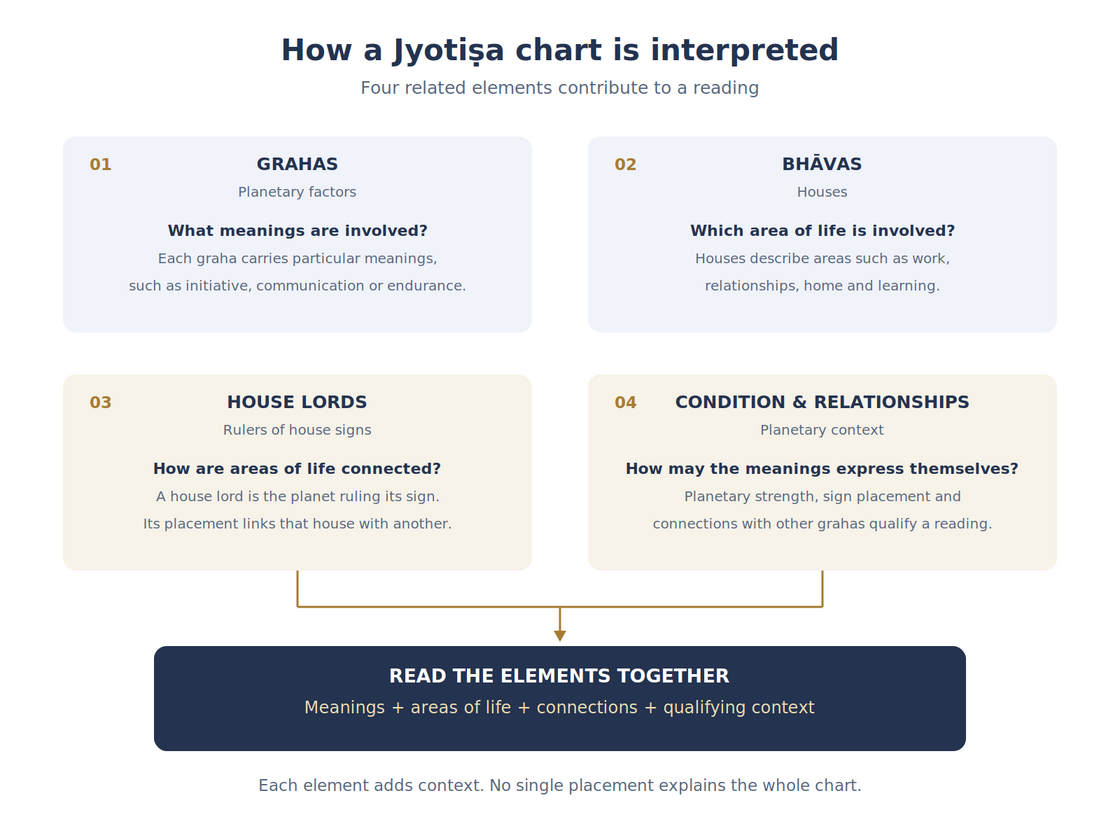
Within Jyotiṣa, an astrologer considers several related elements:
- Grahas, the planetary factors, carry particular meanings.
- Bhāvas, or houses, describe areas of life.
- House lords, the planets ruling the signs associated with those houses, help connect different areas of the chart.
- Planetary condition and relationships help qualify how those meanings may express themselves.
A planet’s placement is therefore one part of an interpretive process. Its house, the houses it rules and its connections with other planets all contribute to the reading.
For beginners, it helps to distinguish between questions such as:
- Is there an indication of ability?
- Are there opportunities to use that ability?
- Does using it involve pressure, delay or sustained effort?
- What other factors support or complicate the picture?
Ability, opportunity and ease are different things. A chart may be read as supporting one while showing difficulties with another.
Support and difficulty can coexist
Consider someone who is capable and respected in their work but finds professional life exhausting.
There is no contradiction in that experience. Success can come with demanding responsibilities, limited flexibility or persistent pressure.
Similarly, someone may value relationships deeply while finding commitment difficult. A person may communicate confidently at work but struggle to express personal feelings. Someone may enjoy learning while finding formal education frustrating.
These everyday examples help explain why a chart reading needs more detail than “good for career” or “bad for relationships”.
The astrologer’s task is to examine what supports a particular area of life, what places demands on it and how those indications relate.
A supportive factor does not automatically remove every difficulty.
A difficult factor does not automatically eliminate every possibility of fulfilment.
An example: the impulse to act and the need to proceed carefully
Mars and Saturn offer a useful introduction to contrasting planetary meanings.
In traditional Jyotiṣa symbolism, Mars is associated with initiative, drive and decisive action. Saturn is associated with restraint, endurance, responsibility and processes that take time.
When these planets are connected in a chart, an astrologer considers how those different tendencies interact. Depending on the wider context, their relationship might be interpreted through themes such as frustration, disciplined effort or achievement requiring persistence. The combination needs to be examined as a whole.
Imagine a person who wants to move quickly but also feels a strong need to prepare thoroughly. Sometimes that tension could make starting difficult. In another setting, it could support careful, sustained work. This example does not mean that every Mars–Saturn connection produces the same experience. The houses involved, rulerships and condition of both planets matter.
It demonstrates a basic principle: contrasting meanings can interact without becoming identical.
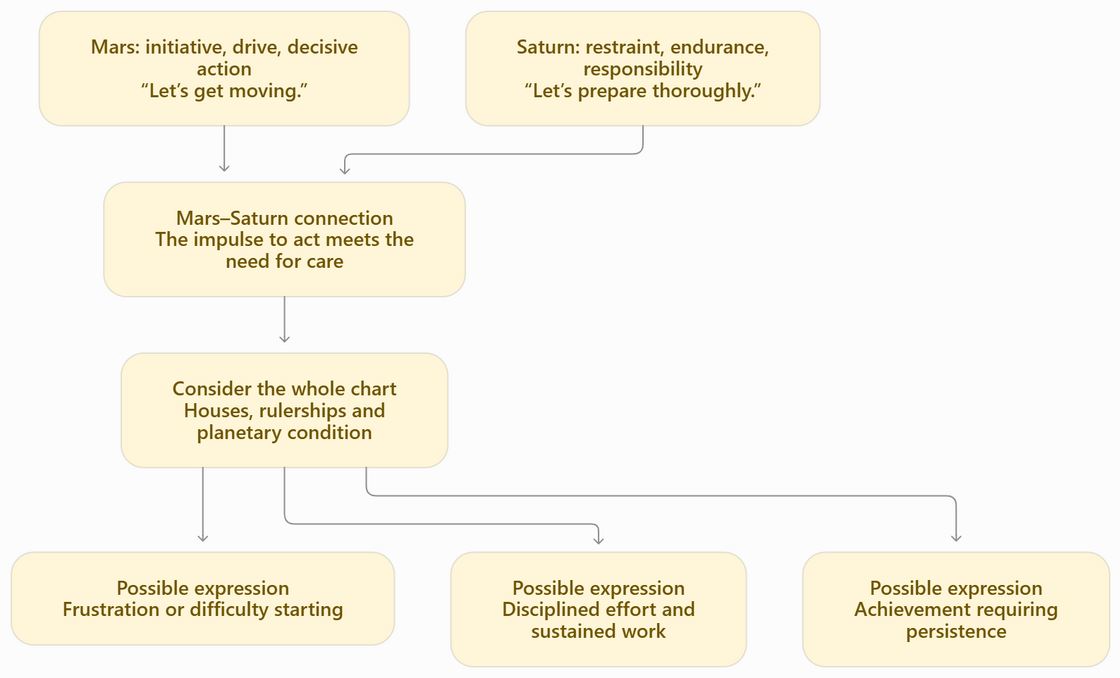
The same contrast can express itself differently. Mars’s drive and Saturn’s restraint remain distinct; the wider chart helps an astrologer assess how they may work together. These are illustrative possibilities, not guaranteed outcomes.
Contrasting indications do not simply cancel each other out
It can be tempting to treat interpretation as a balancing exercise:
One supportive factor plus one difficult factor equals a neutral result.
That approach loses useful information.
If a chart contains indications of both opportunity and delay, “nothing much happens” may be a poor summary. The relationship between those factors could be central to the interpretation.
Nor does the presence of contrast mean every indication carries equal weight.
An astrologer needs to assess which factors are more strongly supported, how directly they relate to the question and whether the same theme appears elsewhere in the chart.
This is why interpretation involves judgement. Counting favourable and unfavourable placements cannot replace understanding how they work together.
Timing adds another layer
Contrasting themes may also become prominent at different stages of life.
Jyotiṣa uses daśās, or planetary periods, alongside transits to consider the timing of chart indications. These methods form part of the tradition’s approach to how experiences unfold over time.
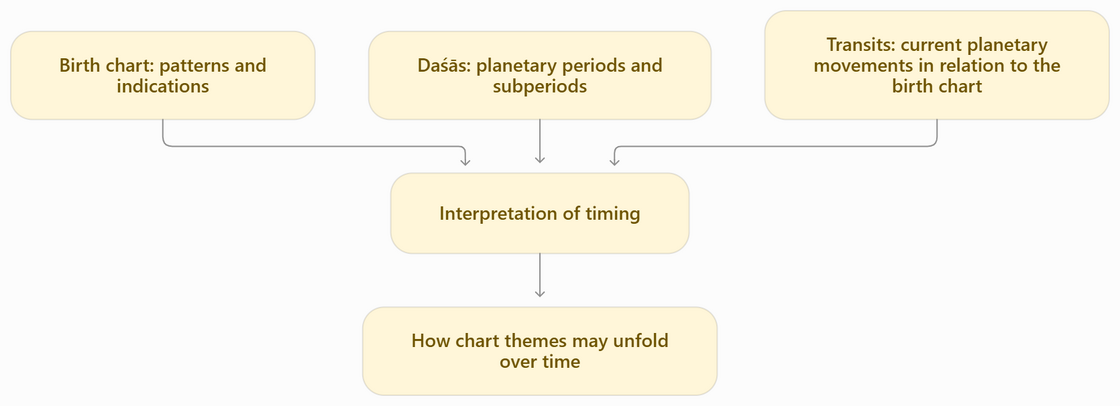
The birth chart provides the context. Daśās help an astrologer assess which planetary indications may become prominent during a period. Transits add context through the planets’ ongoing movements. These are considered together when interpreting timing.
For example, a person’s life may include periods of greater outward activity and periods in which private responsibilities require more attention.
The birth chart remains the same, but the focus of a reading changes when timing is considered.
A planetary period is also interpreted through that planet’s role in the individual chart. A Saturn period, for instance, cannot be described adequately by applying a general list of Saturn meanings to everyone.
For beginners, the useful point is straightforward: indications do not necessarily express themselves with the same emphasis throughout life.
Why online descriptions can make contrast confusing
Looking up placements separately often produces a collection of statements that seem incompatible.
One description says a person is independent. Another says relationships are important. A third emphasises caution, while a fourth describes confidence.
Some of these statements may be too broad. Others may describe different contexts. They may also come from different interpretive approaches.
Reading them together does not automatically produce a coherent chart reading.
A general placement description usually leaves out much of the information needed to qualify it. It may say little about house rulership, planetary condition, other influences or timing.
When descriptions disagree, it helps to examine what each is actually claiming. Are they discussing the same area of life? Are they describing motivation, ability, circumstances or an eventual outcome?
Those distinctions can reveal that two statements were never answering the same question.
Making room for complexity without making everything fit
Recognising contrast does not give an astrologer permission to explain any experience after the fact.
If every possible outcome can be made to fit an interpretation, the interpretation becomes difficult to assess.
A more disciplined approach identifies the factors being considered, explains why they matter and acknowledges what remains uncertain.
For someone beginning to study Jyotiṣa, useful questions include:
- What does each factor indicate in this context?
- Are these factors addressing the same topic?
- Which indications receive support elsewhere in the chart?
- What qualifies or limits the initial interpretation?
- Does timing help explain when a theme may become prominent?
The aim is to develop a reading that accounts for the evidence in the chart without forcing all of it into one simple message.
Sometimes that means recognising a dominant theme alongside a meaningful complication. Sometimes it means keeping more than one possibility open until further examination supports a clearer conclusion.
Learning to interpret confluence and contrast
Recognising repeated themes is one step towards reading a chart. Understanding contrasting themes develops that skill further.
Together, confluence and contrast help students move beyond memorised definitions towards a more coherent interpretation. They encourage careful attention to how the parts of a chart relate to one another and to the person whose chart is being read.
Big Shakti’s Jyotisa Foundations Program introduces this process through four sequential levels.
In Level 2, students learn to combine the meanings of grahas and bhāvas, recognising patterns of confluence and contrast as the larger narrative of a chart begins to emerge.
Live classes, work with real charts and interpretive mentorship sessions called Digestions give students opportunities to explore these relationships, ask questions and develop their understanding through practice.

Comments