

In Jyotiṣa, or Vedic astrology, a placement gains meaning through its relationship with the rest of the chart. Two people can share one feature while differing in many of the factors that qualify it.
A shared placement provides a point of comparison. It does not provide a complete description of either person.
What do we mean by “the same placement”?
When people compare charts, “the same placement” can mean several things:
- The same planet in the same zodiac sign.
- The same planet in the same house.
- The same planet in both the same sign and house.
These are different degrees of similarity.
Two people with Mercury in the tenth house may have Mercury in different signs. Two people with Mercury in Virgo may have it in different houses.
Even when the planet, sign and house match, other planetary positions and connections may differ.
Before comparing interpretations, it helps to establish exactly what is shared.
A planet’s general meanings are the starting point
Each graha, or planetary factor, has traditional associations.
Mercury, for example, is associated with communication, learning, analysis and exchange. Its placement gives an astrologer somewhere to begin, but those general meanings need to be considered alongside its house and relationships with other chart factors.
Mercury in the tenth house may therefore prompt an astrologer to investigate how Mercurial themes relate to work, public activity or responsibility.
That still leaves many possibilities.
Communication could involve teaching, writing, negotiation or explaining complex information. Analysis could appear in research, accounting or technical work. Exchange could be relevant to trade or business.
These are examples of activities that draw on Mercury’s broad symbolism. They are not a list of careers guaranteed by this placement.
The distinction matters: a theme can have several expressions.
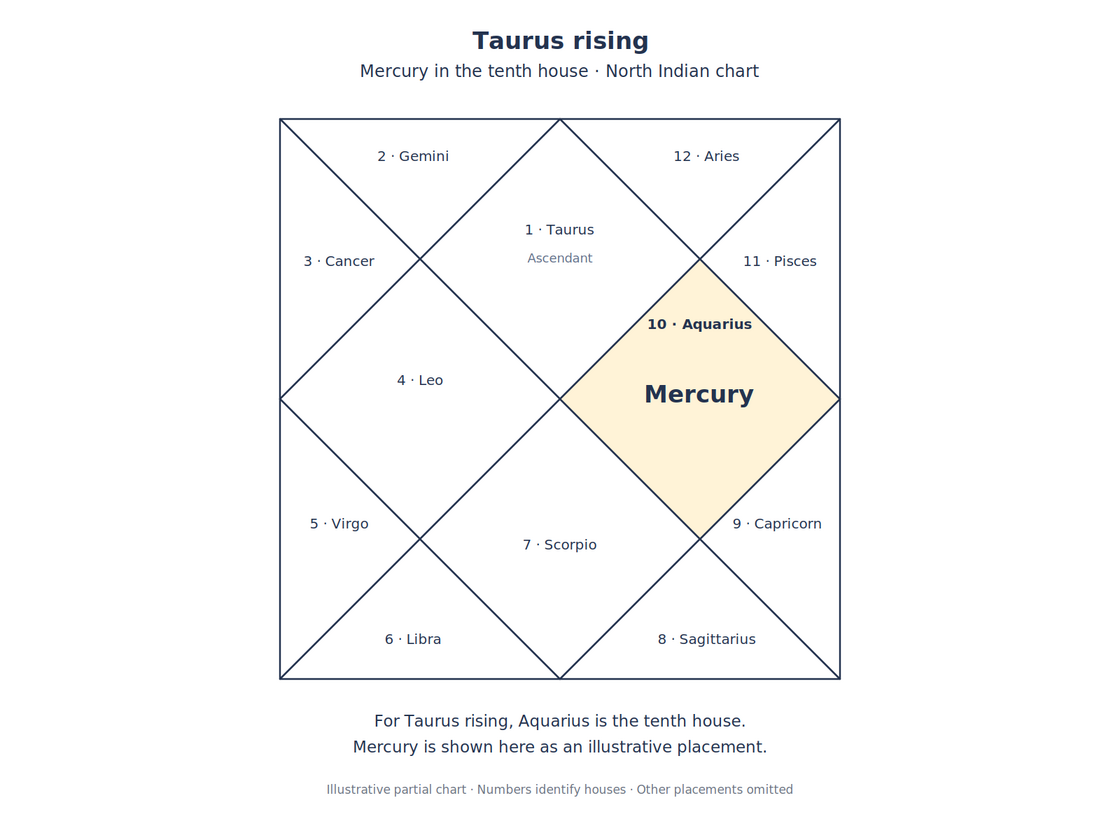
The sign changes the context
Let’s stay with Mercury in the tenth house.
If Mercury occupies different signs in two charts, the placements are already less alike than they first appear.
In Jyotiṣa, signs form part of the assessment of planetary condition. The planet ruling the sign Mercury occupies also becomes relevant to the interpretation.
This ruling planet is sometimes called the dispositor. It provides another connection that an astrologer examines when assessing the placement.
For a beginner, there is no need to memorise every possible combination immediately. The useful principle is that a planet operates within a context, and its sign contributes to that context.
“Mercury in the tenth house” leaves that information unspecified.
House rulership gives the planet a particular role
A planet also has responsibilities within an individual chart through the houses it rules.
These rulerships depend on the ascendant, the sign rising at birth.
Consider two illustrative charts using whole-sign houses:
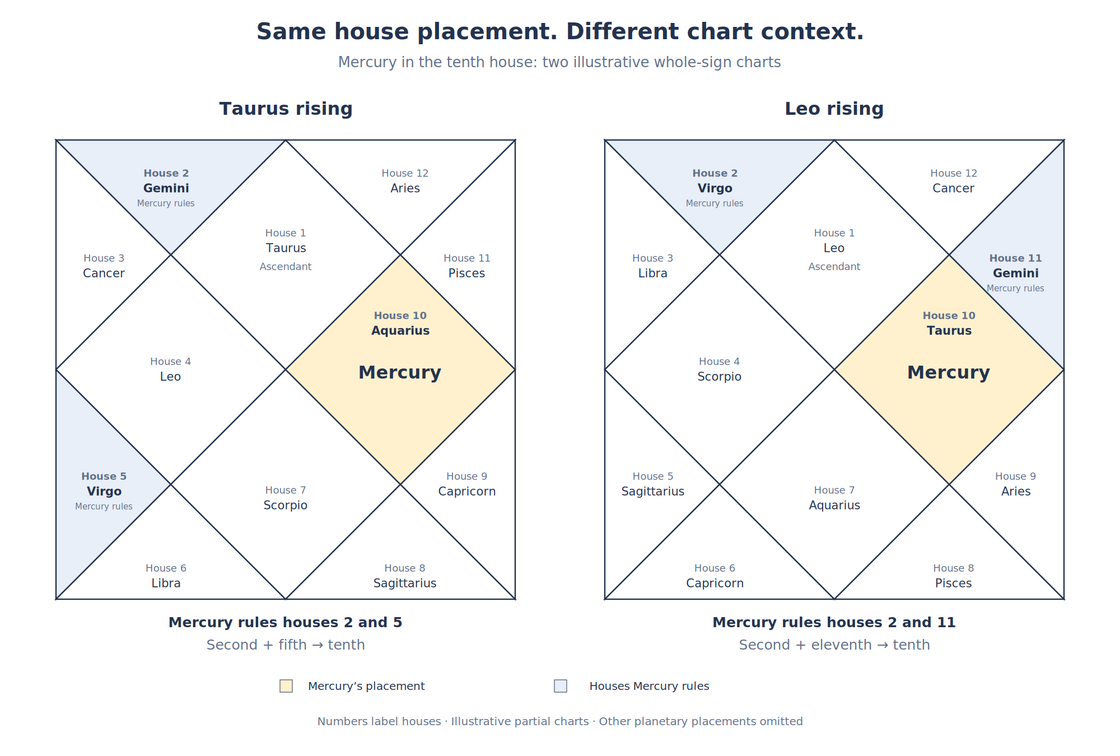
In both examples, Mercury occupies the tenth house. But its sign and one of its house rulerships differ.
The fifth house includes themes such as learning, children and creative intelligence. The eleventh includes gains, networks and the fulfilment of aims. These different rulerships give the astrologer different relationships to investigate.
This does not establish a specific outcome for either chart. It shows why the same house placement cannot carry an identical interpretation in every case.
Other planets qualify the picture
Mercury alone in a house is also a different configuration from Mercury sharing that house with another graha.
An astrologer considers conjunctions and aspects, the traditional relationships through which planets are interpreted together.
Those connections can add support, pressure or competing tendencies. Their meaning depends on the planets involved and their roles in the particular chart.
Hart deFouw’s explanation of chart interpretation emphasises this relationship between the individual placement and the whole: its meaning develops through examining the surrounding factors.
This is why a general description can only go so far. It usually leaves out the very relationships that make one person’s chart different from another’s.
The wider chart may reinforce or complicate a theme
A shared placement might be part of a repeated pattern in one chart and a more isolated indication in another.
For example, several factors may support a connection between communication and professional life. In another chart, Mercury’s placement may sit alongside stronger indications concerning different kinds of work.
This introduces the principles of confluence and contrast.
Confluence occurs when several factors support a similar theme. Contrast appears when indications point in different directions or qualify one another.
An astrologer examines both. The task involves assessing how much weight a particular placement deserves within the larger pattern.
Simply finding the placement does not complete that assessment.
Timing can differ too
Two people may share a natal placement while passing through different planetary periods.
Jyotiṣa uses daśās, or planetary periods, alongside transits when considering how chart themes unfold over time. Timing therefore adds another dimension to the comparison.
One person may be in a period that brings a particular planet’s indications into greater prominence. Another may be experiencing a different emphasis.
Comparing their current circumstances without considering timing leaves out part of the traditional interpretive process.
Even a shared placement does not imply that related experiences occur at the same age or in the same sequence.
People bring different circumstances to similar themes
A chart reading also concerns a person living in particular circumstances.
Education, family responsibilities, culture, resources and available opportunities all shape the forms that a life can take.
Someone with an interest in communication might develop it through formal study. Another might use it in a family business, community role or practical trade.
Recognising these differences helps keep interpretation specific and grounded. It also prevents broad planetary symbolism from being mistaken for a precise prediction.
A theme such as communication does not, on its own, tell us someone’s job title, level of income or satisfaction with their work.
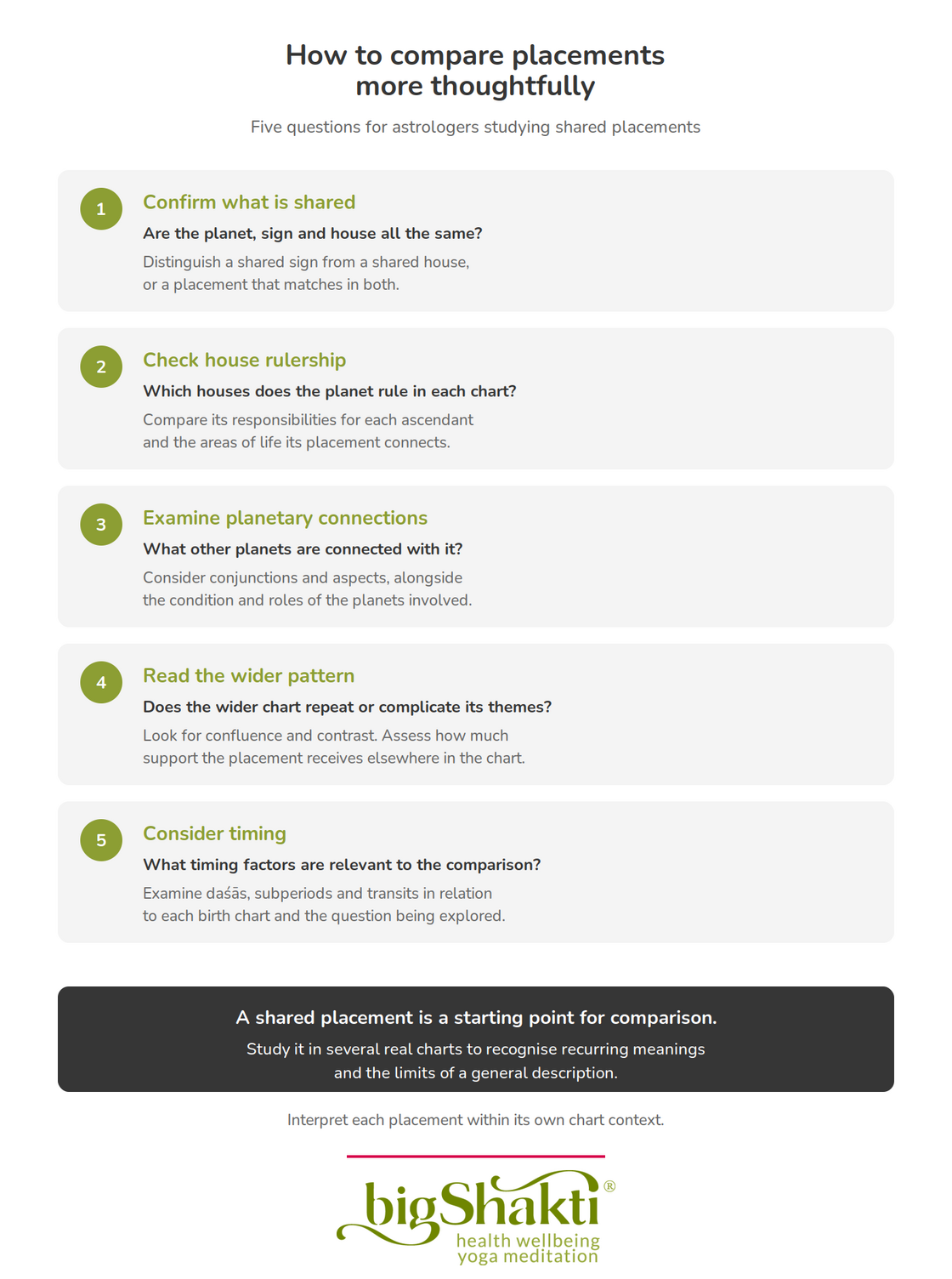
How to compare placements more thoughtfully
When you discover a placement you share with someone else, begin with a few questions:
- Are the planet, sign and house all the same?
- Which houses does the planet rule in each chart?
- What other planets are connected with it?
- Does the wider chart repeat or complicate its themes?
- What timing factors are relevant to the comparison?
These questions help move the discussion beyond “we have the same placement, so why are we different?”
They also make studying real charts valuable. Seeing one placement in several contexts helps students recognise both its recurring meanings and the limits of a general description.
Learning to read placements in context
Understanding planetary meanings is an essential foundation. Learning how those meanings change through their relationships is the next stage.
In Level 2 of Big Shakti’s Jyotisa Foundations Program, students begin weaving together the meanings of grahas and bhāvas, recognising confluence, contrast and the larger narrative emerging from a chart.
Work with real charts, live participation and interpretive mentorship sessions called Digestions provide opportunities to explore why similar placements can contribute to different readings.
Through practice, students develop a more careful understanding of what a placement suggests, what qualifies it and what further information is needed.

Comments