

A student opens a Jyotiṣa text and finds a description of a planetary combination. The conditions seem clear, and the stated results are striking: learning, prosperity, recognition, or difficulty.
The student locates the combination in a birth chart. Has the chart now been interpreted?
An important observation has been made. But several questions remain:
- Does the combination meet all the stated requirements?
- What is the condition of the planets involved?
- How does it relate to other indications?
- What can reasonably be said about its significance for this person?
Classical texts provide a foundation for interpretation. Learning to apply their teachings requires careful study, guidance, and practice.
This relationship between written knowledge and practical understanding is central to learning Jyotiṣa.
What do classical vedic astrology texts contribute?
Classical Jyotiṣa literature preserves definitions, classifications, combinations, and methods through which students learn to examine a chart. These teachings provide a shared language. They help us distinguish a recognized principle from an interpretation based only on personal association.
When studying yogas, this becomes especially important. A yoga has defining conditions. We need to understand those conditions before deciding that a combination is present.
The text gives us something specific to investigate. Without that reference, we may notice an interesting arrangement and attach an appealing explanation to it. With a clear definition, we can begin asking more disciplined questions about what the chart actually contains.
For an introduction to these combinations, see What Are Yogas in Vedic Astrology?
A written rule can contain more than we first notice
Reading a technical statement requires attention to its individual terms:
- Does it refer to a particular planet, or the ruler of a house?
- Is a position counted from the ascendant or from the Moon?
- Does the statement include a requirement concerning strength?
These distinctions can change which charts meet the rule.
A useful first exercise is to explain the passage in plain language without adding anything to it. If we cannot describe its requirements clearly, we are not yet ready to apply it confidently.
This is one reason foundational study matters. Familiarity with grahas, signs, houses, and rulerships makes it possible to understand what a text is asking us to examine.
The vocabulary gradually becomes usable knowledge.
Identifying a yoga and assessing it are different tasks
A written definition helps establish whether a yoga forms. Assessment examines how it functions within the individual chart.
Traditional evaluation considers the condition of the participating planets, their house rulerships, influences from other grahas, and relevant timing factors. This further examination is often described as qualifying the yoga.
Consider the difference between these statements:
“I have found the combination described in the text.”
“I have assessed its significance within this chart.”
The second statement requires more work.
Our article on how astrologers assess the strength of a yoga introduces the questions involved in making that assessment.
Reading the surrounding teaching
An isolated sentence can be difficult to interpret accurately when we do not understand its place within a larger explanation.
When studying a passage, it helps to ask:
- What subject is being discussed?
- Which terms have already been defined?
- What conditions does the statement specify?
- Are further qualifications discussed elsewhere in the teaching?
- Which parts of the explanation come from the text, and which come from commentary?
These questions encourage careful reading. They also help us avoid treating a short extract found online as a complete lesson.
For students working in translation, recording the edition and translator is useful. It allows us to return to the same wording, compare explanations thoughtfully, and ask a teacher about a specific passage.
Precision makes discussion more productive.
What a teacher adds to textual study
A teacher can demonstrate how to move from a written principle to a considered interpretation.
This involves explaining the reasoning: what is being examined, why it matters, and what prevents an initial conclusion from being accepted too quickly.
Hart deFouw describes Jyotiṣa interpretation as a process in which individual factors are understood through the whole chart, while the whole becomes clearer through attention to its parts. That capacity develops through sustained training and guided practice.
In a learning environment, students can ask questions that a printed definition cannot answer on its own:
- Have I identified this correctly?
- Why are we giving this factor more weight?
- What changes when another planet is involved?
- Which part of this conclusion remains uncertain?
The opportunity to examine those questions is part of how understanding develops.
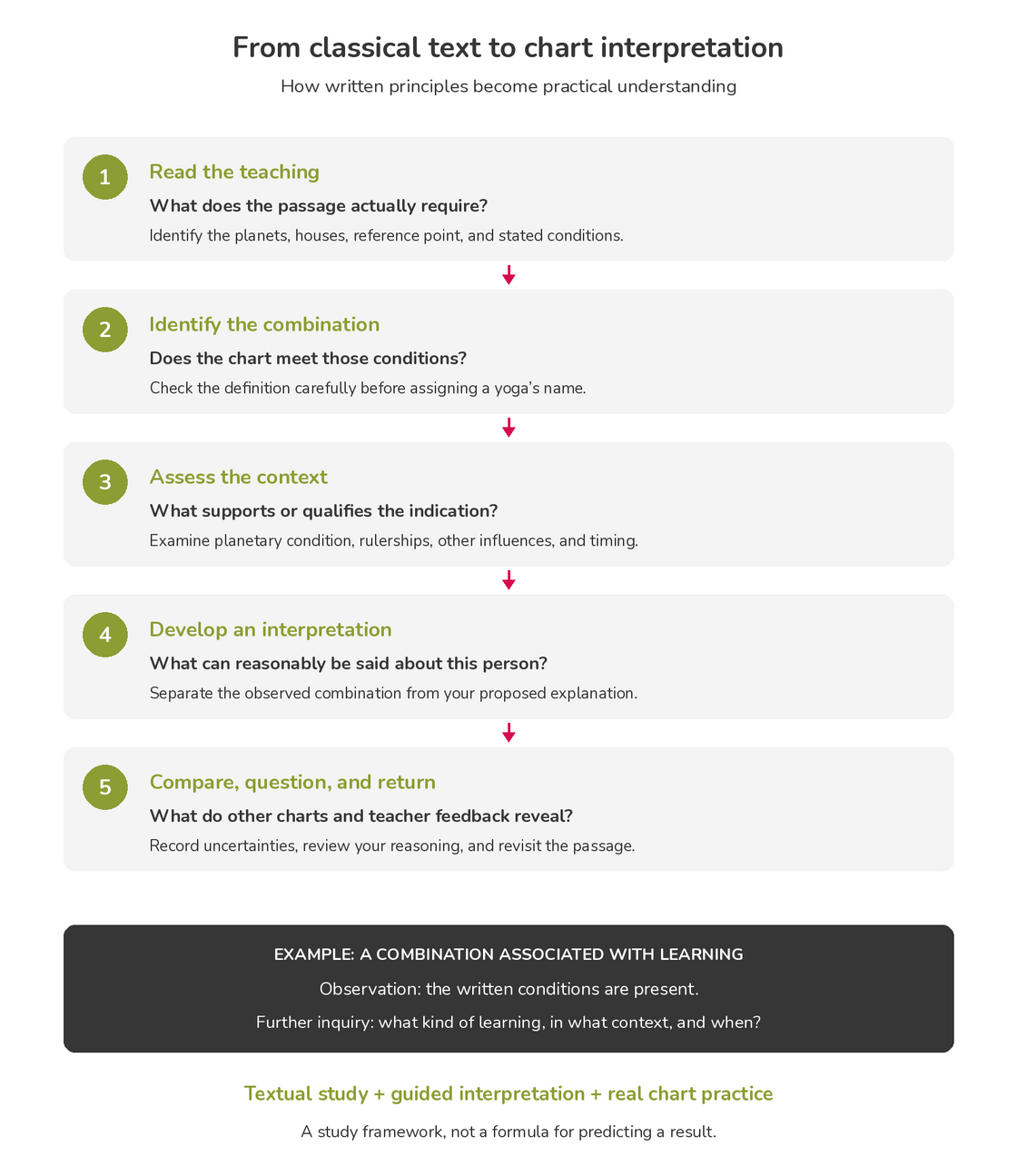
An example: studying a combination associated with learning
Imagine that we are studying a yoga traditionally associated with learning.
Our first task is to establish its definition. We identify the required planets and relationships, then check whether the example chart meets those conditions.
Next, we examine the participating grahas and the wider chart.
Only then do we begin discussing the interpretation.
Even the word “learning” needs care. Are we considering intellectual ability, access to education, sustained study, qualifications, or teaching? These are related experiences, but they are not identical.
The exercise might develop as follows:
| Stage of study | Question |
|---|---|
| Read the definition | What does the passage require? |
| Identify the combination | Are those conditions present? |
| Assess the context | What supports or qualifies the indication? |
| Consider the interpretation | What subject can we reasonably discuss? |
| Review the reasoning | Where have we moved from observation to inference? |
This sequence helps make the learning process visible.
It also prevents us from turning “a combination associated with learning” immediately into “this person will achieve academic distinction.”
Why studying several charts matters
One example can introduce a principle. Several examples allow us to examine its application more carefully.
When comparing charts, we can record what remains similar and what changes. Perhaps the same combination appears with different house rulerships, planetary conditions, or timing factors.
This encourages us to investigate the reasons for different interpretations.
It is helpful to keep notes that separate:
- The rule being applied.
- The factors observed in the chart.
- The interpretation proposed.
- The known circumstances.
- The questions that remain unresolved.
Known life details can help us review an interpretation, but they can also tempt us to make every factor fit what we already know.
A useful discipline is to record the initial reasoning before examining the outcome in detail. Unexpected examples then become opportunities to question our understanding.
Respecting the text includes questioning our reading
If a passage seems inconsistent with a chart example, there are several possibilities to investigate.
We may have misunderstood a term, overlooked a condition, applied the rule incorrectly, or drawn a conclusion that is too specific. The interpretation itself may need revision.
Respectful study allows room for this inquiry.
It does not require us to defend our first explanation at all costs. Nor does it require us to force someone’s experience into a description because we believe we have identified a yoga.
As we discussed in the article 'Does Having a Yoga in Your Birth Chart Guarantee a Particular Outcome', recognizing a combination begins an assessment.
I encourage students to become comfortable saying, “I need to examine this further.” That is a useful response when it leads to closer study and clearer questions.
Bringing written knowledge into practice
I approach textual study as a continuing conversation between the teaching, the chart, and our developing understanding.
We read carefully. We apply the principle. We explain our reasoning. We ask for guidance and return to the passage with better questions.
Over time, this process helps us recognize patterns without relying only on memorized descriptions. It also develops the ability to communicate an interpretation with appropriate care.
The value of a text becomes increasingly apparent as we learn how much attention its application requires.
Study texts and charts through the Jyotiṣa Foundations Program
Our Jyotiṣa Foundations Program develops this understanding through four sequential levels. Students begin with the chart’s foundations and learn to combine planetary and house meanings. In Level 3, we work directly with texts to identify yogas and assess whether and how they may bear fruit within the wider chart.
Find out more about the Jyotiṣa Foundations Program.
If you would like to explore questions about your own chart, you can also enquire about a private Jyotiṣa consultation.

Comments