

Finding a yoga in a birth chart can be exciting. A recognizable combination appears, and we begin exploring what it might signify.
But recognition raises another question: how much importance does this combination deserve?
In Jyotiṣa, assessing a yoga involves examining the factors that support, modify, or limit its expression. We look at the participating grahas, their relationships, and the broader pattern of the chart.
A yoga’s name tells us which combination to investigate. Its assessment helps us understand what we can reasonably say about it.
This is where learning definitions begins to develop into interpretive judgment.
What do astrologers mean by “strength”?
When discussing yogas, “strength” can refer to several related considerations.
We may be asking about the strength of an individual planet, how well a combination meets its defining conditions, or how much support its indications receive within the chart.
These are connected questions, but they are not identical.
A planet can have a significant strength while also carrying a weakness. For example, traditional assessment recognizes both sign-based condition and directional strength. One does not automatically erase the other.
For beginners, the useful principle is to avoid treating “strong” as a synonym for “everything will be easy.”
We need to establish what is strong, in which respect, and how that contributes to the interpretation.
First, does the yoga actually form?
Before assessing strength, we check the definition.
Does the combination require particular planets, house rulers, signs, or relationships? Are all those conditions present?
A simplified description may leave out an important requirement. Different texts or teaching traditions may also specify a combination differently.
The starting point is therefore a clear rule applied consistently.
Birth information matters here. Where a yoga depends on the ascendant, house positions, or house rulerships, uncertainty in the birth time can affect whether the combination is identified correctly.
If you are unfamiliar with how combinations form, begin with What Are Yogas in Vedic Astrology?
What is the condition of the participating grahas?
Once the combination is established, we examine its participants.
Introductory questions include:
- Which signs do the grahas occupy?
- Do they have recognized strengths or weaknesses?
- What other planets influence them?
- Are their conditions consistent, or mixed?
Traditional considerations include occupation of a planet’s own sign or exaltation sign, proximity to the Sun, and other planetary conditions. Their relevance needs to be assessed together rather than turned into isolated verdicts.
The terminology can become detailed quickly. At this stage, understanding the purpose of the examination matters more than memorizing every technical rule.
We are investigating the condition of the factors through which the yoga is interpreted.
Which houses are involved?
Houses help locate the subject of the reading.
An astrologer considers where the combination occurs and which houses its participating planets rule. The ascendant establishes those rulerships, giving each planet particular responsibilities within the chart.
This encourages greater precision.
Suppose a description associates a yoga with achievement. Are we investigating professional responsibilities, education, resources, or another subject? What chart factors justify that emphasis?
Without this step, a broad word such as “success” can become whatever we want it to mean.
For a refresher, Planets and Houses in Vedic Astrology introduces how planetary meanings interact with areas of life.
How does the combination relate to the person?
The ascendant and its ruler are important reference points when assessing how a favorable yoga connects with the individual. Traditional evaluation considers their condition and their relationship with the combination.
For students, this raises a useful distinction between an opportunity appearing in someone’s circumstances and their capacity to make use of it.
An invitation to teach, for example, differs from having the preparation, confidence, and available time to accept it.
That everyday example illustrates the distinction; it is not a prediction attached to a particular placement. It reminds us to ask how a proposed interpretation relates to the person’s actual situation.
What supports or contrasts with the interpretation?
A useful assessment looks beyond the combination itself.
We ask whether other relevant factors reinforce the emerging theme, qualify it, or suggest a competing consideration.
This brings us back to two principles explored earlier in this series:
- Confluence: several relevant factors supporting a similar theme.
- Contrast: indications that introduce different tendencies or conditions.
The practical task is to explain the relationship between those observations.
Consider the difference between these two statements:
“This combination indicates professional achievement.”
“There are indications supporting professional development, alongside factors requiring closer examination of the demands involved.”
The second statement makes the qualification visible. A fuller reading would explain the particular factors behind it.
Precision develops when we can show why we have reached a conclusion.
Timing is a further consideration
A yoga’s natal assessment and its timing assessment address related questions.
The first concerns the combination within the birth chart. The second concerns when its indications may become prominent. Relevant planetary periods form part of traditional yoga evaluation.
A beginner does not need to calculate a complete timeline to appreciate the distinction.
Two people may have similar combinations while experiencing different stages of life. Comparing their present circumstances without examining timing leaves part of the inquiry unfinished.
Our introduction to dashas and planetary periods explains the basic timing framework.
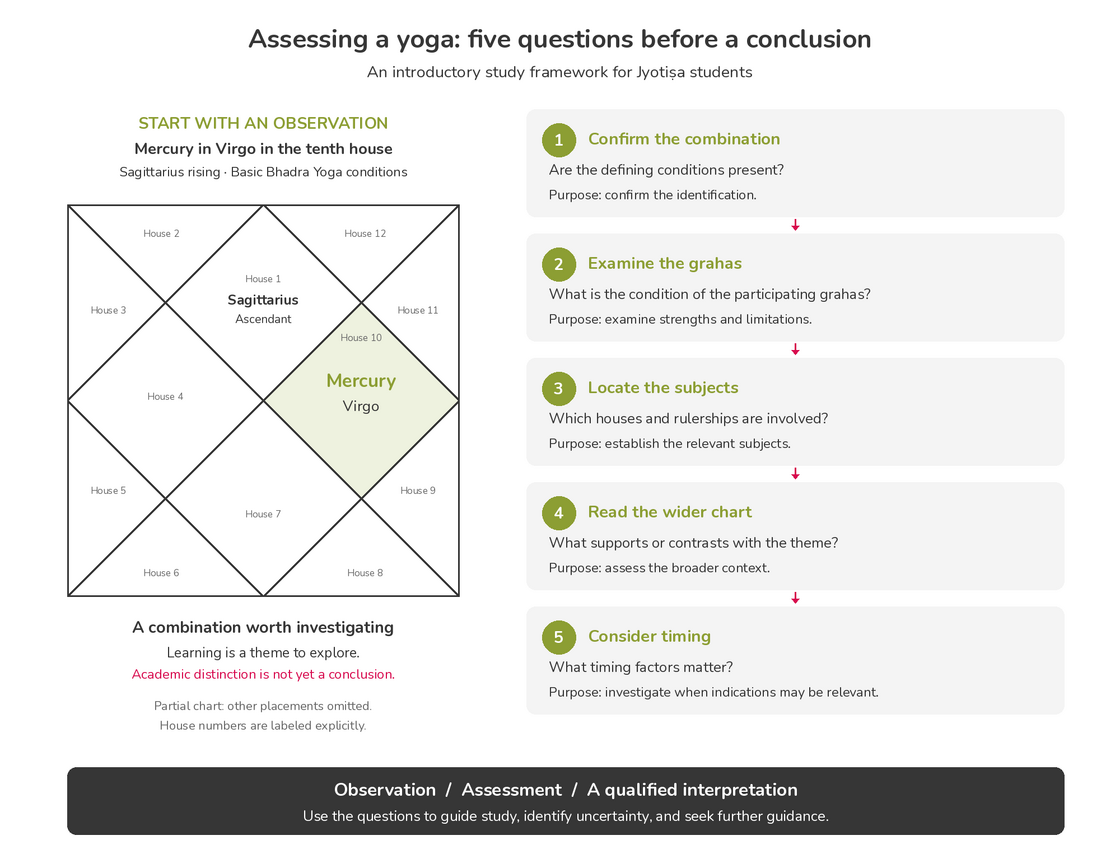
An example of the assessment process
Imagine that a student identifies a combination traditionally associated with learning.
Instead of immediately predicting academic distinction, the student develops a set of questions:
| Question | Purpose |
|---|---|
| Are the defining conditions present? | Confirm the identification |
| What is the condition of the participating grahas? | Examine strengths and limitations |
| Which houses and rulerships are involved? | Establish the relevant subjects |
| What supports or contrasts with the theme? | Assess the broader context |
| What timing factors matter? | Investigate when the indications may be relevant |
This is a study framework rather than a formula for calculating a result.
It helps distinguish an observation from an inference. It also reveals where further information or guidance is needed.
Assessment develops through practice
When studying Jyotiṣa, it is tempting to search for a single rule that settles every question. Real charts soon show us why judgment takes time to develop.
I encourage students to explain their reasoning clearly: what they have identified, what supports their interpretation, and what remains uncertain.
Comparing several charts is valuable because it tests our understanding. We begin to see where a general description is useful and where it requires qualification.
The aim is to give each combination appropriate weight within a coherent reading.
Learn to assess yogas through guided study
Our Jyotiṣa Foundations Program builds these skills across four sequential levels.
After learning the foundations and combining planetary and house meanings, students work with yogas in Level 3. The emphasis is on understanding their definitions and assessing whether and how they may bear fruit within the wider chart.
Live teaching, work with real charts, and interpretive mentorship sessions called Digestions support this gradual development of understanding.
Find out more about the Jyotiṣa Foundations Program.
If your interest concerns a combination in your own chart, you can also enquire about a private Jyotiṣa consultation.

Comments