

You look up a planetary placement in your Vedic birth chart and find a description that feels remarkably familiar.
Then you read another article about the same placement. This one gives a different impression. A third seems to contradict both.
Which description applies?
A useful place to begin is with what each description actually considers. An article about one planet in one sign or house explores a small part of the chart. It cannot account for all the relationships that make your chart individual.
In Jyotiṣa, a placement gains meaning through its context. Learning to examine that context is an important step toward understanding the chart as a whole.
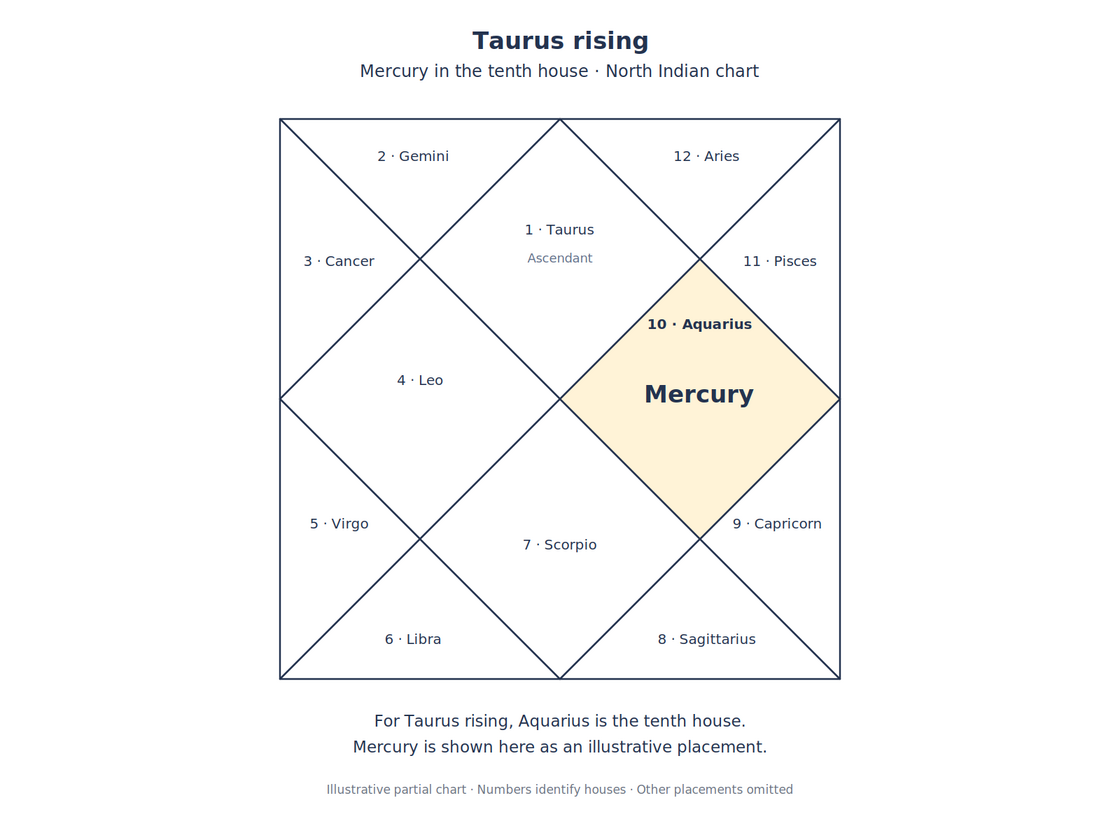
A placement is a starting point
A statement such as “Mercury is in the tenth house” identifies something worth exploring.
Mercury’s associations with learning, speech, and exchange meet the tenth house’s subjects of work, action, and public standing. This gives us an initial connection to investigate.
But the statement leaves several questions unanswered:
-
Which sign does Mercury occupy?
-
Which houses does it rule?
-
Are other grahas joining or influencing it?
-
What is its condition?
-
Is its planetary period active?
These factors help an astrologer assess how the placement participates in the wider chart.
The initial observation is useful. The difficulty arises when we expect it to provide a complete answer.
Why online descriptions can feel contradictory
A short placement description has to simplify. It may focus on a graha’s natural meanings, a particular house association, or one possible expression of the combination.
Another writer may emphasize a different aspect.
For example, an introductory description of Saturn might discuss discipline and endurance. Another might focus on delay and restriction. Both draw on traditional associations, but neither tells us which subjects are most relevant in a particular chart.
Descriptions can also differ because they use different astrological approaches. A Western interpretation and a Jyotiṣa interpretation may share some vocabulary while applying different frameworks.
When comparing articles, ask:
Are these descriptions discussing the same placement, within the same system, and under the same conditions?
Sometimes the apparent contradiction comes from comparing explanations that answer different questions.
The graha’s natural meaning is only one layer
Each graha has natural significations. Venus is associated with relationships, pleasure, and beauty; Jupiter with wisdom, teachers, and growth.
A graha also takes on a particular role through the houses it rules in an individual chart.
This distinction matters. Jupiter’s general reputation does not establish that everything associated with it will unfold easily. Likewise, Saturn’s demanding associations do not mean it can only produce difficulty.
Jyotiṣa considers both a graha’s inherent nature and its function within the chart.
This is one reason broad labels such as “good planet” or “bad placement” provide so little information. They leave out the relationships needed to understand the particular case.
The ascendant changes the context
The lagna, or ascendant, establishes the starting point for the houses in the basic birth chart. As the rising sign changes, the houses ruled by each graha change too.
Consider Venus, which rules Taurus and Libra:
| Ascendant | Houses ruled by Venus in the whole-sign framework |
|---|---|
| Aries | Second and seventh |
| Capricorn | Fifth and tenth |
Venus retains its natural meanings in both charts. However, its house responsibilities differ.
For Aries rising, Venus connects with second- and seventh-house matters. For Capricorn rising, it connects with fifth- and tenth-house matters.
Even if Venus occupied the same house in both charts, its role would not be identical.
A description that leaves out the ascendant and house rulership therefore leaves out a substantial part of the interpretation.
Other grahas contribute to the picture
A graha is also studied through its relationships with other grahas.
Two important terms are:
-
Conjunction: grahas occupying the same sign, with their exact separation providing further detail.
-
Aspect: a relationship through which a graha influences another part of the chart according to the rules being used.
These relationships can reinforce, complicate, or modify an initial interpretation.
“Venus in the fourth house,” for example, does not tell us whether Venus is alone or involved with other grahas. It also leaves out influences reaching the fourth house from elsewhere.
The surrounding chart helps establish what the brief placement description cannot.
Timing adds another distinction
A birth chart remains the natal reference, but Jyotiṣa also examines timing.
Dashas identify calculated periods associated with particular grahas. Transits describe current planetary movement.
A placement may become more relevant when the appropriate period is active. Subperiods introduce further distinctions within a longer span.
This helps explain why a chart description may not seem equally applicable throughout life. A person’s experiences during one period cannot automatically be extended to every other period.
Timing still requires chart context. Knowing that someone is in a Venus period does not tell us what Venus signifies for them individually.
Different parts of life can tell different stories
People are rarely consistent in every setting. Someone may speak confidently at work while finding personal conversations difficult. They may handle demanding responsibilities well while feeling uncertain about their next direction. A chart can likewise contain indications that support one another in some areas and contrast in others. The task is to understand which factors relate to which subjects.
An indication about professional activity does not automatically describe partnership, family life, or emotional experience. Keeping the question specific helps prevent a narrow observation from becoming a sweeping statement about the person.
Repeated themes deserve attention
As study develops, an astrologer looks for confluence: several relevant factors pointing toward a similar theme.
A possible connection between learning and work becomes more meaningful when other chart factors support that connection.
Contrasting indications need attention too. They may qualify the interpretation or show why the subject requires a more nuanced explanation.
This involves weighing relationships rather than collecting every description and treating them all as equally decisive.
A useful beginner’s habit is to distinguish three things:
| Stage | Example |
|---|---|
| Observation | Mercury occupies the tenth house. |
| Initial interpretation | Communication or learning may be relevant to work. |
| Conclusion requiring further support | The person earns their living through teaching. |
Moving carefully between these stages makes your reasoning clearer.
How to use placement descriptions constructively
A short article can introduce vocabulary and give you questions to explore. Use it as a study aid.
When you read one, consider:
-
What factors does it include? A sign, a house, an aspect, or several conditions?
-
What information is missing? Rulership, planetary condition, timing, or other influences?
-
Is it describing a possibility or claiming certainty?
-
Does it address a particular area of life or make a claim about the whole person?
You can recognize something familiar without deciding that every statement applies. You can also find a description unfamiliar without forcing your experience to fit it.
The aim is to develop understanding through observation, questions, and practice.
Learn to see the relationships within a chart
Big Shakti’s Jyotiṣa Foundations Program offers a structured pathway from individual chart components toward coherent interpretation.
Level 1 establishes the vocabulary and structure. Level 2 develops your ability to combine grahas and bhāvas, recognize confluence and contrast, and begin understanding the larger narrative emerging from a chart.
Real chart examples, live participation, homework, supported study groups, and interpretive mentorship sessions known as Digestions help you practice bringing these factors together.

Comments