
This year has been a quieter one for us at Big Shakti — quieter on the outside, at least. We have been settling into a new chapter, taking stock of what we have built over the past twenty-five years, and asking ourselves how we most want to direct our energy from here.
The answer, for both of us, has become increasingly clear: we want to write and teach. Our focus is on developing deep, considered work that does justice to the body of knowledge we have accumulated over a quarter of a century of practice, study, and teaching. That is where our hearts are, and this is the sankalpa we have made.
Swami Shankardev is immersed in a series of books and courses on mantra, chakras, and kuṇḍalinī — and on how all of these integrate into a coherent system of yoga psychology and spiritual development. The first of these, Light on Mantra Yoga, is ready for publication, and a series of 3 live courses accompanies it.
Jayne is developing her Sankalpa: The Ancient Art of Creating Positive Change Course, which we think will be genuinely transformative for those who take it. Sankalpa, the art of making a deep inner resolve, is far more than goal-setting. In Jayne's hands, it becomes a complete system of self-development in its own right: Sankalpa Yoga. It is designed to help students and clients get clear on what they truly need in their lives right now, and to build the inner ground from which that clarity can actually take root and bear fruit. More on that soon.
Jayne's Sankalpa course perfectly dovetails with the Mantra Yoga Course because we cannot direct the energy of the mantra, the mantra shakti, without a firm sankalpa attached to our mantra practice. As well, the information within the mantra has to fit the purpose, the sankalpa we make, so this is where the mantra course supports the sankalpa course.
For now, we want to share what is ready.
Blessings
— Jayne & Swami Shankardev
Behind the Scenes
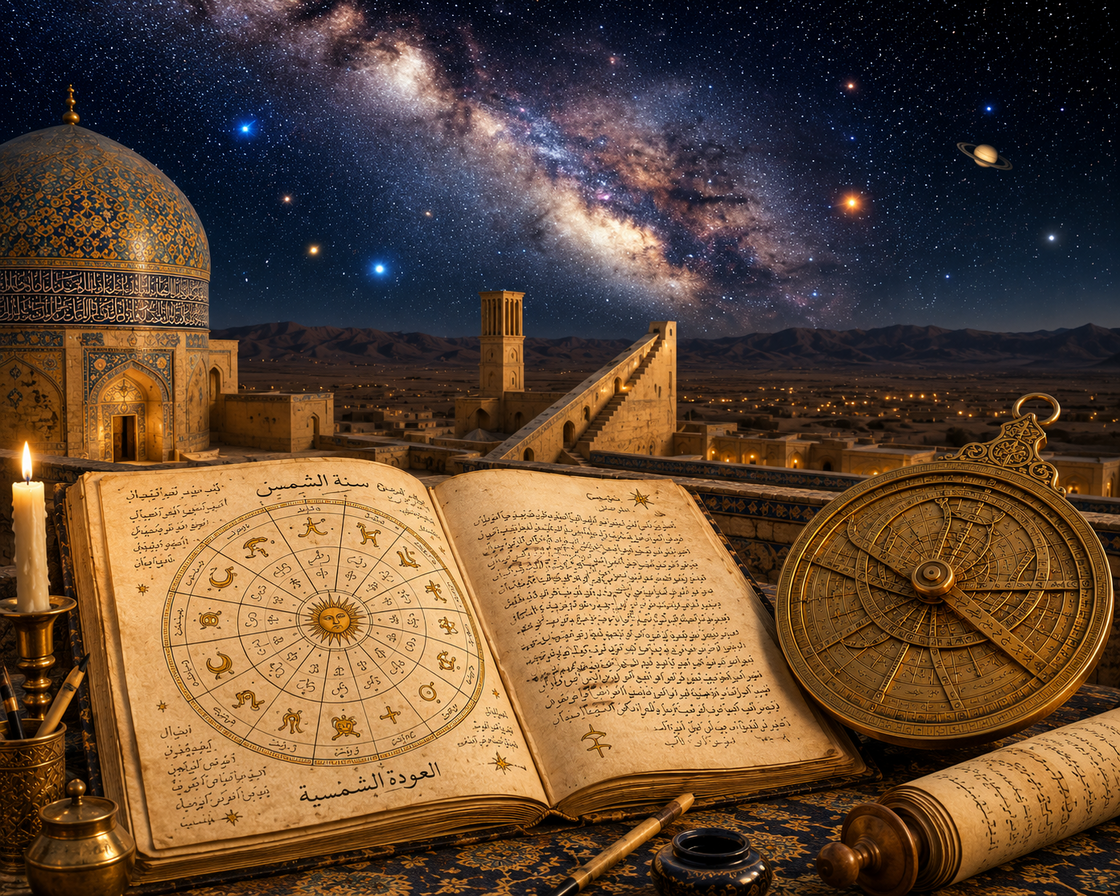
A New Lens on Time: Arabic Astrology, Solar Return, and the Fruits of the Year
Swami Shankardev has just completed a course in Arabic astrology and solar return with Hart de Fouw, one of the most respected and learned teachers of Jyotiṣa — Vedic astrology — in the Western world.
The focus of this study was varṣaphala, a Sanskrit term that translates literally as "the fruits of the year." The idea is elegant and deeply practical: each year, at the precise moment the sun returns to the exact degree it occupied at the time of your birth, we can cast a new chart. That chart serves as an annual forecast, revealing whether the year ahead is likely to unfold with relative ease and support, or bring challenge, pressure, and the need for careful navigation. Far from being a source of anxiety, this knowledge is genuinely liberating — it allows us to prepare, to use our practices with greater precision, and to meet whatever the year brings with awareness rather than surprise.
What makes this system especially fascinating is its cosmological lineage. The Arabic and Tajik traditions of astrology are distinct from classical Indian Jyotiṣa, with their own principles, techniques, and philosophical assumptions. Where Indian astrology developed from the Vedic and Puranic worldview, the Arabic and Tajika schools emerged from a confluence of Persian, Hellenistic, and Islamic astronomical traditions, carrying a different sensibility and a different set of tools. Learning to work with both streams deepens the overall picture considerably, allowing us to cross-reference insights and arrive at a richer, more nuanced understanding of how time, karma, and cosmic cycles interact in a human life.
As a natural extension of this work, he is also about to begin a course in astronomy — not simply as an academic pursuit, but as a way of making the horoscope come alive as a genuinely three-dimensional experience. Most of us encounter astrology as symbols on a two-dimensional chart, abstracted from the actual sky. Studying the real movements of the planets, their cycles, their relationships to the sun and earth as living celestial bodies, restores the horoscope to its proper context and gives the whole system a tangibility and immediacy that chart-reading alone cannot provide.
Indian astrology (jyotish) consultations are now available.
Podcast: The Yoga Informed Therapist
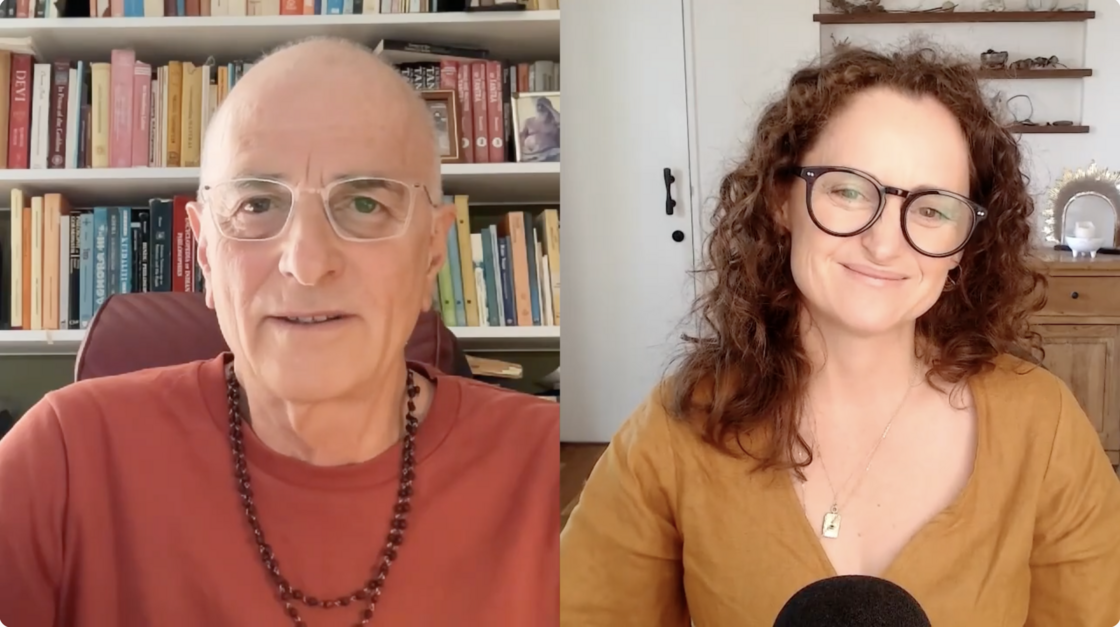
Swami Shankardev was recently interviewed by Dr. Lauren Tober as part of The Yoga-Informed Therapist Interviews ~ a series that brought together therapists and yoga teachers who are integrating these two worlds with care, depth, and ethical rigor. The series covered the scope of practice, nervous system regulation, trauma sensitivity, and the training pathways that allow this kind of integration to be done responsibly.
🔖 Tune in Here →
Three Courses, One Journey: Introducing the Light on Mantra Yoga Series
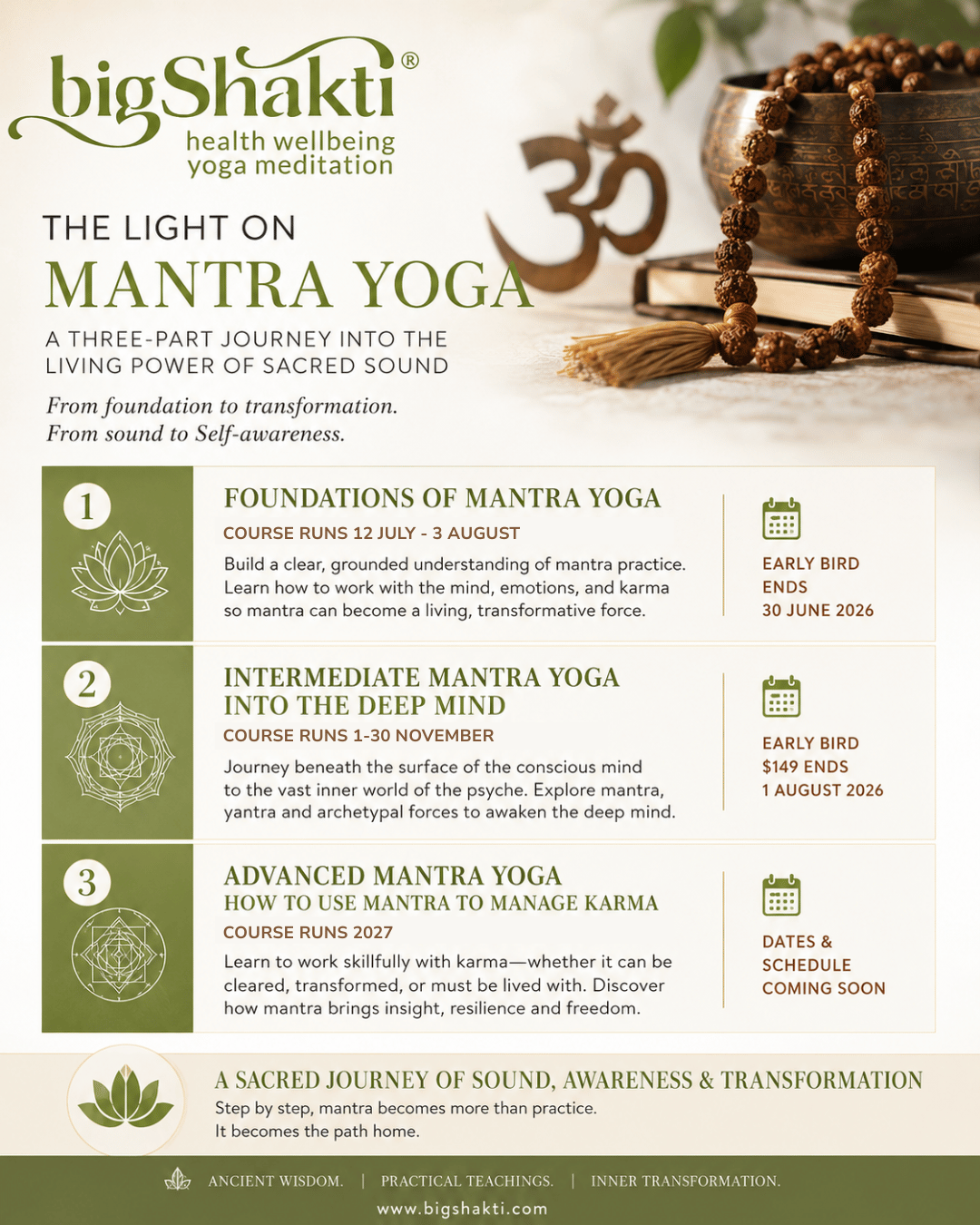
The Light on Mantra Yoga series unfolds across three courses, each consisting of four weekend seminars. Each course builds on the one before it, and together they constitute a complete map of the inner journey that mantra practice is actually inviting us to undertake.
The aim of this trilogy is to develop a community — a saṅgha — of students committed to delving deeply into mantra yoga as a living path of self-inquiry. At its heart, this is an invitation to engage with some of the great classical tantric texts not merely as objects of intellectual study, but as mirrors for direct inner experience. We come to these texts not to accumulate knowledge about them, but to use them as guides that illuminate and expand our understanding of the psyche's inner landscape.
What makes this combination so powerful is that mantra practice itself prepares the mind for a different quality of reading. When we bring a mind refined by sustained mantra yoga to the sacred texts, something shifts: the intellect relaxes its grip, and a subtler faculty opens. We begin to penetrate into the heart of the text as an intuitive experience rather than an analytical one, understanding not only with the thinking mind but with the whole of our awareness.
That said, there is no obligation to walk the full three-course path. Students who wish simply to attend one or two courses to gain a deep, grounded understanding of how to practice and integrate mantra yoga into daily life are equally welcome, and that in itself is a rich and complete goal. The series is designed to meet you where you are and to give generously at every stage of the journey.
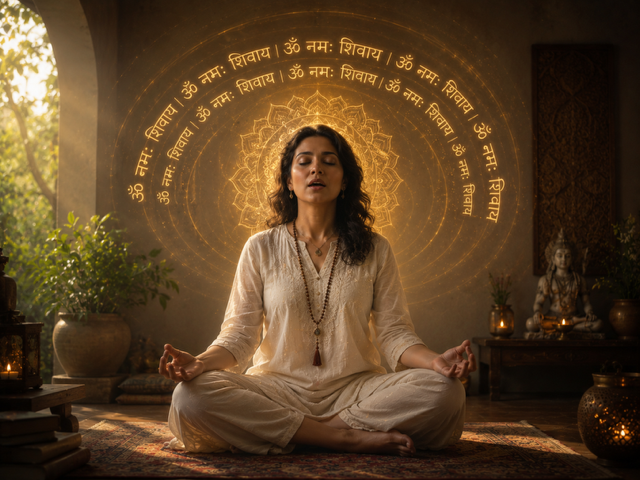
What Is Mantra Yoga
Mantra Yoga is the yogic science of using sound, vibration, and repetition to influence the mind, emotions, energy, and consciousness. In the yogic tradition, mantras are not simply affirmations or positive phrases; they are considered subtle sound formulas that carry specific energetic and psychological effects.
Through repetition of mantra (silently, aloud, or combined with breath and meditation) the scattered mind gradually becomes more focused, steady, and calm. Traditionally, Mantra Yoga has been used to help quiet mental agitation, regulate emotional states, strengthen concentration, awaken deeper awareness, and reconnect the practitioner with a more centred state of being.
At its heart, Mantra Yoga is a practice of inner refinement: using sound as a tool to reshape mental patterns, restore balance, and cultivate greater clarity, resilience, and presence.
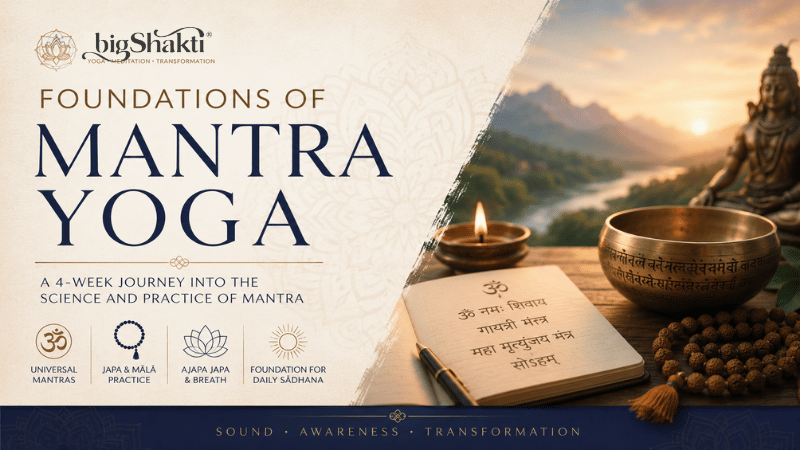
Foundations of Mantra Yoga
The first course in the series is open to practitioners of all levels, from those taking their first serious steps with mantra to those who have been practicing for decades. Whatever your experience, this course invites you to examine the foundations of your practice with fresh eyes.
Many of our students tell us they are using a mantra but feel stuck and unable to advance. They have read about the amazing things mantras can do, but find themselves at a point where they do not know the path forward. Perhaps their minds are still restless. Perhaps old emotional patterns keep resurfacing. Perhaps the practice feels more like a habit than a living encounter with something real and transformative. If any of this sounds familiar, we designed this series specifically for you.
This course will begin to answer questions about how to use mantra to address our karma, support our strengths and abilities, alleviate the negative karma that is obstructing our progress, and, of course, strengthen positive karma.
Many of us hold subtle gaps in our understanding that quietly limit what mantra can do for us. This course brings those gaps to light and fills them in with clarity. Alongside the technical foundations, we work directly with the superficial mind, the surface layer of thinking and emotional life that mantra must pass through before it can reach the depths.
Old anxieties, habitual resistances, self-doubt, and scattered attention are not signs that mantra yoga does not work. They are the very material that practice is meant to address. In this course, we learn how to work with that material skillfully so that the mantra can actually land where it needs to.
Intermediate Mantra Yoga - Into the Deep Mind
The second 4 week course in the series takes our awareness beneath the surface of the conscious mind. Once we have stabilized our relationship to the outer mind, we can begin to engage with what lies deeper: the vast inner world of the psyche, chitta, the unconscious reservoir where mantras actually live as primal vibrations, or proto-thoughts, before they ever take the form of language or conscious thought.
This is where mantra practice becomes genuinely transformative. We explore the relationship between sacred sound and sacred symbol, between mantra and yantra, and between the tantric understanding of archetypal forces and the Jungian framework of the unconscious. Consciousness and symbol meet in the deep mind, and in that meeting, something essential is awakened.
Advanced Mantra Yoga - How to Use Mantra to Manage Karma
The third course turns toward the question that every sincere practitioner eventually faces: what am I really doing, and where is this practice taking me?
At the heart of the third course, and threading through the entire series, is a teaching that we consider among the most important we can offer: how to use mantra to work with karma wisely and effectively.
Not all karma is the same, and not all of it asks the same thing of us. Some karmic patterns are relatively accessible. With the right mantra and a consistent practice, they begin to shift, sometimes with surprising speed. The mantra accelerates the process by empowering our self-awareness, sharpening our intuition, and building the inner momentum that genuine change requires.
Other karmas are more complex. They require a different quality of engagement: steadiness, alertness, and the training to remain grounded while moving carefully through territory that is not yet fully understood. Here, the mantra does not simply dissolve the difficulty. It teaches us how to hold ourselves together in the midst of it. Progress with this kind of karma often moves in stages. We find ourselves caught in it, then briefly free of it, then caught again — and each time we escape its gravity, even momentarily, we return with a new insight, a clearer understanding of what we are actually dealing with and what the next step requires.
And then there is a third kind of karma: the deep soul wound. Some burdens cannot be removed. They are woven into the fabric of who we are and what we came here to carry. This is where mantra reveals one of its most profound gifts. It does not always liberate us from karma; sometimes it enables us to live within it with grace, stability, and even a growing sense of meaning. What once felt like a prison begins to reveal itself as a threshold. What seemed only like suffering begins to carry, faintly at first and then more clearly, the quality of a blessing.
This is what the series is ultimately here to teach, and it is a teaching that cannot be delivered in a single weekend or even three. It unfolds over time, over the three courses and in the practice that continues beyond them, in the relationship between student, teacher, and the living tradition we are all drawing from together.
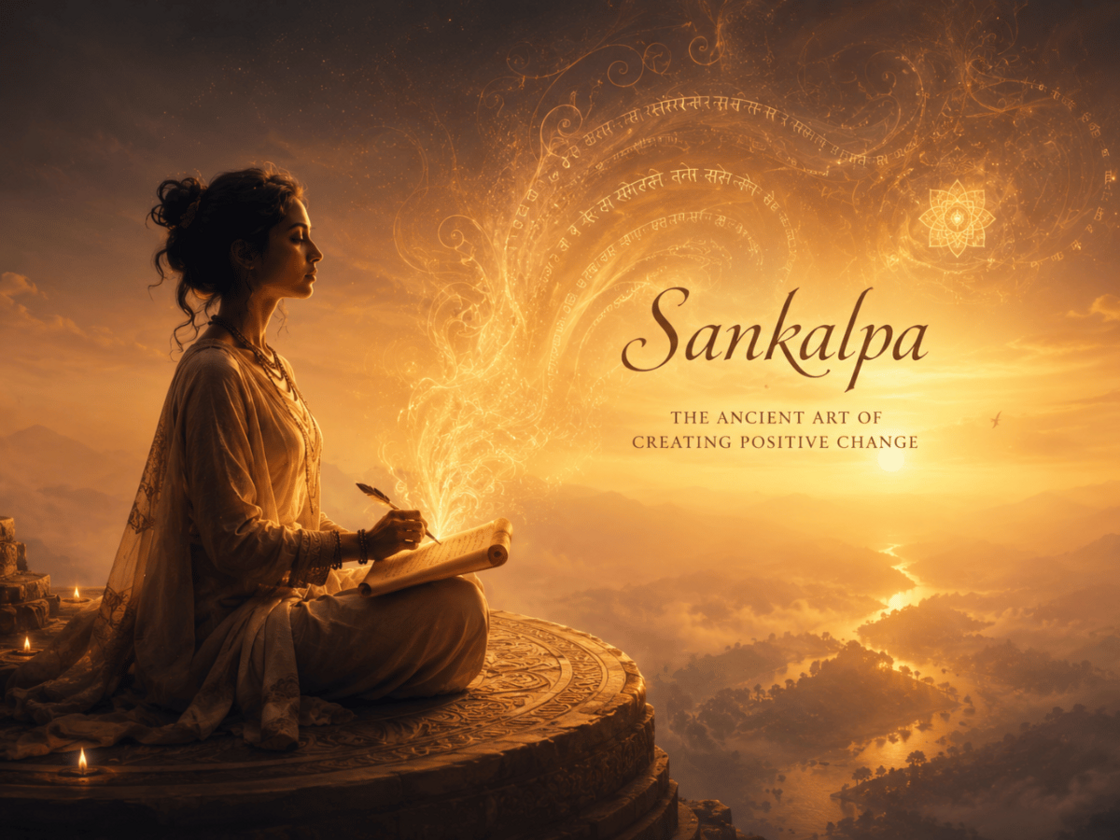
Sankalpa: The Ancient Art of Creating Positive Change Course
This teaching dovetails naturally with Jayne's dedicated Sankalpa: The Ancient Art of Creating Positive Change Course, in which she guides students through the full art and science of forming a sankalpa with depth and precision.
This interactive series will explore Sankalpa as a deeper practice of intention, self-awareness, and meaningful change through the lens of yoga psychology, reflection, meditation, and inner inquiry.
REGISTER INTEREST FOR THIS COURSE
Together, these offerings give you both the philosophical ground and the practical tools to use intention as a genuine spiritual instrument. They are available as individual courses; however, we recommend joining us for the full journey for the fully transformative experience they offer.
That's all from us for now. Take care and stay well 🧘🏼
Dr Swami Shankardev Saraswati & Jayne Stevenson
Connect with us on...
INSTAGRAM | FACEBOOK | LINKEDIN | YOUTUBE

Comments