

The Science of Sacred Sound and the Transformation of Consciousness
There is a common misunderstanding in the modern world that mantra is simply the repetition of sacred words for relaxation or devotion. While mantra can certainly calm the mind and open the heart, the real tradition of Mantra Yoga is far deeper, more precise, and more psychologically sophisticated than many people realise.
Mantra Yoga is an ancient science of consciousness. It is a method of working directly with sound, vibration, attention, breath, and the deeper structures of the psyche in order to bring about psychological integration, energetic balance, concentration, healing, and spiritual awakening.
In the yogic and tantric traditions, sound is not merely something we hear. Sound is considered one of the fundamental forces through which consciousness expresses itself. Before thought becomes language, before emotion becomes behaviour, there is vibration. Mantra works at this primal level of the mind.
This is why mantra practice has been used for thousands of years not only by yogis and meditators, but also by healers, mystics, contemplatives, and spiritual practitioners seeking to understand and transform the deeper patterns of human consciousness.
Mantra Is More Than Words
The word mantra comes from two Sanskrit roots:
- man — mind
- tra — liberation or protection
A mantra is therefore a tool for liberating the mind from restrictive patterns and conditioning. This is important to understand.
Mantras are not simply affirmations or positive thinking exercises. In the classical traditions, mantras are considered vibrational structures that influence the nervous system, prāṇa (life force), attention, and the deeper unconscious layers of the psyche.
The ancient yogis discovered that certain sounds affected consciousness in very specific ways.
Some calm the mind.
Some awaken energy.
Some stabilise emotion.
Some increase concentration and clarity.
Some stimulate courage, compassion, devotion, or insight.
Over time, these sound structures were refined into the sophisticated systems of Mantra Yoga found within yoga and tantra traditions.
The Yogic View of the Mind
One of the reasons Mantra Yoga remains so relevant today is that it offers an extraordinarily practical understanding of the mind.
Yoga psychology teaches that much of our behaviour is driven by unconscious impressions and habitual mental patterns known as samskaras. These are accumulated tendencies formed through past experiences, emotions, conditioning, and repetition.
Modern psychology recognises similar phenomena through concepts such as conditioning, trauma responses, emotional patterning, and neural pathways.
Mantra practice works directly with these deeper structures. Through repetition, attention, breath, and vibration, mantra gradually introduces new patterns into the mind while loosening the grip of old reactive tendencies. In this sense, mantra is both contemplative and therapeutic. It is not about suppressing the mind, but more about reorganising and trasmuting it.
How Mantra Works
Mantra works through two interconnected forces:
1. Vibration
Each mantra produces a particular vibrational effect within the body and nervous system. These vibrations influence breath rhythms, emotional states, concentration, and energetic balance. Certain sounds stimulate calmness and regulation, while others activate vitality, clarity, or focus.
The yogic traditions understood long ago that sound affects physiology and consciousness.
Modern neuroscience is now beginning to confirm many of these observations through research into:
- nervous system regulation
- breath and vagal tone
- neuroplasticity
- emotional regulation
- attentional training
- meditation and brainwave activity
2. Attention
The second component is attention itself.
The mind normally moves in endless loops:
- worry
- memory
- anticipation
- emotional reaction
- internal commentary
Mantra provides the mind with a stable rhythm and point of focus.
Over time:
- mental agitation decreases
- emotional reactivity softens
- concentration improves
- inner steadiness develops
- awareness deepens
The mantra becomes an anchor that gradually redirects consciousness away from fragmentation and toward integration.
Mantra as a Bridge Between Psychology and Spirituality
One of the beautiful aspects of Mantra Yoga is that it can be approached from multiple perspectives.
A therapist or psychologist may understand mantra through:
- nervous system regulation
- attentional training
- subconscious repatterning
- emotional processing
- trauma-informed meditation
A spiritual practitioner may approach mantra as:
- sacred sound
- devotional practice
- archetypal activation
- awakening consciousness
- connecting to deeper dimensions of Self
Both approaches are valid.
In reality, mantra sits beautifully at the intersection of psychology, spirituality, energy, and consciousness.
Mantra and the Shadow
As mantra practice deepens, it often begins revealing hidden layers of the psyche.
This is why authentic mantra practice is not merely about relaxation. It is also a process of purification and self-awareness.
Old emotional material, unconscious tendencies, and unresolved psychological patterns may gradually surface into awareness. Yoga psychology and Jungian psychology both recognise this process in different ways.
This is one reason why mantra can become such a powerful tool for therapists, yoga teachers, healers, and meditation practitioners.
When approached skilfully and with proper grounding, mantra becomes:
- a stabilising force
- a method of self-observation
- a way of regulating emotion
- a bridge into deeper unconscious material
- a support for psychological integration
The aim is not to reject parts of ourselves, but to bring greater awareness, balance, and coherence to the whole personality.
Mantra and the Nervous System
Many people today live in chronic states of:
- overstimulation
- anxiety
- mental fatigue
- emotional reactivity
- nervous system dysregulation
Mantra practice can be profoundly supportive in these conditions.
The rhythmic nature of chanting and breath-linked repetition helps regulate the autonomic nervous system and gradually establish more coherent internal rhythms.
Practitioners often notice:
- improved sleep
- less mental noise
- reduced anxiety
- greater emotional stability
- increased clarity
- deeper concentration
- more grounded awareness
This is one reason mantra remains so valuable in modern therapeutic and wellbeing settings.
Mantra Is Not Escapism
Authentic mantra practice is not about bypassing life or escaping reality. It is about becoming more present, more aware, and more internally stable.
The purpose of mantra is not to dissociate from life, but to develop the inner steadiness required to engage life consciously.
A genuine practice gradually develops:
- self-awareness
- emotional regulation
- resilience
- concentration
- insight
- compassion
- energetic balance
Over time, mantra becomes less something we do and more a living current running quietly beneath the surface of consciousness.
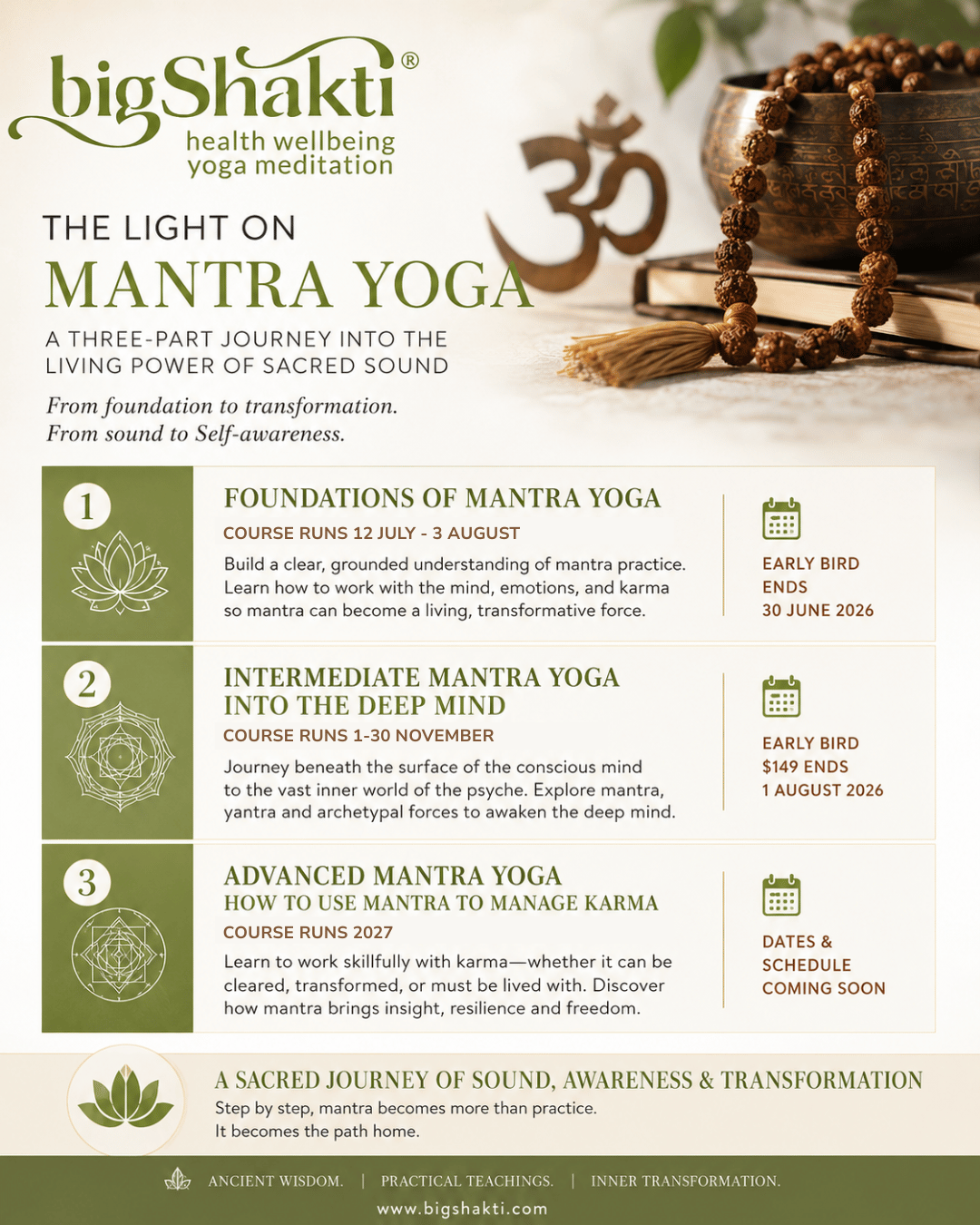
The Mantra Yoga Training Pathway at Big Shakti
At Big Shakti, mantra is taught as both a practical and experiential science.
Our teachings draw from:
- classical yoga
- tantra
- yoga psychology
- meditation traditions
- subtle body theory
- Jungian and depth psychology
- contemplative practice
The focus is not simply intellectual understanding, but direct experience and safe, grounded application.
The Light on Mantra Yoga training pathway explores mantra progressively through three stages:
Light on Mantra Yoga ~ Foundations Course
An introduction to:
- the philosophy of mantra
- sacred sound and vibration
- mantra meditation practices
- concentration and attention
- mantra and the nervous system
- the psychology of sound
- mantra for wellbeing and self-awareness
Suitable for beginners, yoga teachers, therapists, healers, meditators, and anyone wanting a grounded introduction to mantra practice.
🔗 Read more about this course.
Light on Mantra Yoga ~ Intermediate Course
A deeper exploration into:
- the unconscious mind
- mantra and archetypal psychology
- mantra and yantra
- symbolism and consciousness
- deeper meditation states
- subtle body practices
- tantric perspectives on mantra
This stage explores how mantra operates within the deeper layers of psyche and consciousness.
🔗 Read more about this course.
Light on Mantra Yoga ~ Advanced Course
An advanced exploration of:
- mantra and kundalinī
- expanded states of consciousness
- subtle energetic practices
- mantra and spiritual awakening
- advanced tantric frameworks
- the transformative dimensions of sound and consciousness
This stage is designed for committed practitioners ready to engage with the deeper dimensions of mantra yoga.
🔗 Read more about this course.
Mantra Yoga as a Living Practice
Ultimately, Mantra Yoga is not merely a philosophy to study. It is a living practice.
A mantra must be experienced directly.
With patience, repetition, steadiness, and sincerity, mantra gradually becomes:
- a medicine for the mind
- a stabilising force for the nervous system
- a pathway into deeper awareness
- a bridge between psychology and spirituality
- and, ultimately, a means of reconnecting with the deeper dimensions of our own being.
The real power of mantra lies not in belief, but in practice.

Comments