
Many of us in the West were raised on the glittering promise that you can be anyone you want to be. Reinvent yourself as often as the heart demands. It's the basis of modern identity, a freedom so pervasive that we often forget it's there, let alone that it might have a cost. Choice is the ultimate measure of a life well-lived.
But India, in almost every corner, holds up a mirror to that worldview. It is a place that constantly asks you to reconcile your individual free will with the vast, ancient forces of fate and tradition. Nowhere was this more striking than when Swami Shankardev and I visited Dhobi Khana in Fort Kochi, Kerala.
A Legacy Threaded Into Living
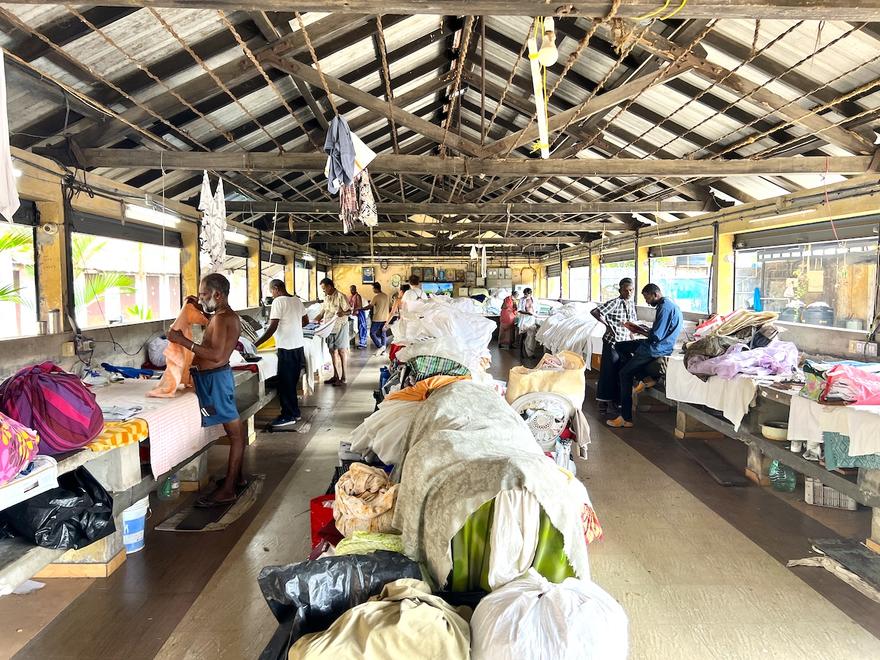
Dhobi Khana means "laundry place," but the term is inadequate. It is a living ecosystem in which history, labor, and identity have evolved since 1720, when the Dutch brought the ancestors of the Vannar Sangham community from across Tamil Nadu and Malabar to clean the uniforms of the colonial army. Three centuries later, the work continues, but today it is for Kerala's hospitals, hospitality industry, and private citizens.

Dhobi Khana - then and now.
As we roamed the workplace, we realized we were witnessing a lineage of labor unbroken for three hundred years. Not a washing machine in sight, the mesmeric sound of cloth slapping stone has echoed through this space since the 18th century. The men move with muscular grace at the ponds, while the utterly robust women, some in their 80s, manage the drying lines and the archaic 8kg charcoal-filled irons with an almost meditative precision and ease.
Every person working here was born into this trade. Ten or more generations have received their work in the same way they received their name: through family. The children growing up among them will likely be next.
The Friction of Tradition and Freedom
I've always known that inherited trades run deep in places like India, but seeing it up close brought an uneasy feeling. I found myself scrutinizing faces for signs of frustration or resentment, looking for the heaviness we often associate with a life unchosen. Swami Shankardev, having lived in India for ten years, moved through the space with recognition.
As we spent time here with the workers, the feeling was anything but heavy. The people here carried themselves with dignity and vitality, and spoke about their work with a matter-of-fact confidence that only comes from mastery. They radiated the settled energy of people who know exactly where they stand in the workplace, perhaps in the world.
Of course, we resist idealizing tradition and inheritance, because everything carries a shadow.
Belonging can be both hugely protective and restrictive. A community can embrace you and keep you wonderfully close, yet it can also draw definitive lines around what is possible in your life. The weight of a predetermined social destiny is a heavy karma that most Westerners would find stifling.
Yet our radical freedom has its own shadow. In India, over 60% of people still work in the same industry as their parents; carrying on the family legacy is seen as dharma, a natural, sacred, and meaningful duty.
In Western culture, we change jobs, move cities, and build lives untethered from our neighbors and our ancestors. We are free, and we are often lonely in our labor, having lost the sense that our work is a thread connecting those who came before and those who will come after. We in the West are very much about the now and me.
The Concept of Inherited Legacy
As we watched the people work with heavy irons, clothes beaten on stone and flapping in the wind, a realization took hold: this can be viewed as a universal story about the essential nature of lineage.
Most of us in the West have used our freedom to break the mold. Choice is a gift, and it often leaves us feeling as though we are building our lives in a self-created vacuum, responsible for inventing meaning from scratch. But if we look more closely and more deeply. If we can see our work and our lives beyond the now and me, we may find we are far less alone than we feel.
Even without a biological vocational lineage, we carry an inherited ancestry of ideas, philosophies, artistic traditions, and frameworks of thought that predate our existence. Whether it is a creative approach, a philosophical worldview, or a commitment to craft, these are the spiritual ponds of wisdom we draw on every day. With a sincere heart, we can preserve a flame lit centuries ago while making it our own.
There is an immense grounding that comes when we stop trying to be so purely self-determined and begin to be faithful to the ideas that deserve preservation.
At Dhobi Khana, identity is something the people are born into. Work is their community, and community is their home. Most of us will never live inside that kind of wholeness. And yet we can recognize something essential in it: the deep human need to feel that our labor belongs to a lineage, a community, a story, or, at the very least, to a theme larger than ourselves.
Bringing the Legacy Home
We left Fort Kochi sitting with one of the many beautiful, messy paradoxes inherent in Indian culture: the grounding beauty of community bonds and the weight of inherited structures.
I invite you to think about your own days in this way. You might have chosen your job or vocation, but have you found a legacy in it?
- Who are the "spiritual ancestors" of the work you do?
- What ancient ideas are you keeping alive through your daily actions?
- Can you feel the "hand-to-hand" transmission of wisdom in your craft, even if it came from outside your biological family?
These questions often arise in my work with clients navigating vocation, career transitions, and retirement. When we recognize that we belong to something larger than ourselves, we find what the workers at Dhobi Khana already know — the ease, dignity, and purpose that come from being part of a living lineage.
Our work at Big Shakti is a synthesis of many long-lived traditions, including Yoga, Jungian psychology, and Western psychology, all focused on sustaining meaning, connection, and relevance with the modern world. We are so glad to have you in our community, and we are honored to carry that baton alongside you.
If you're grappling with these questions yourself, seeking depth, resonance, and direction in your life and work or vocation, our Find Life Purpose course is an excellent place to begin. It guides you inward, helping you discover what truly matters to you and how to bring it forward into your daily life.

Jayne and Swami Shankardev - India Feb 2026
{Photos by the author with permission. 1870s photo of a Dhobi Washerman ironing, taken from Wikipedia}

Comments