

In recent years, there has been increasing interest in chakras and kundalini, particularly in relation to mental and emotional well-being. Much of what is presented, however, tends to move either toward abstraction or exaggeration. For this reason, it is helpful to return to the classical view within yoga.
In the yogic tradition, chakras are not objects to be activated or forced open. They are functional centres within the subtle body that reflect how prāṇa is organised and expressed.
When prāṇa is steady and well-regulated, the mind tends toward clarity.
When prāṇa becomes disturbed (scattered, obstructed, or depleted) this disturbance is experienced as agitation, dullness, or emotional instability.
From this perspective, many common psychological states can be understood in energetic terms:
Anxiety reflects a movement of prāṇa that is ungrounded and dispersed.
Depression reflects a predominance of inertia, where energy becomes heavy and withdrawn.
Emotional reactivity arises when prāṇa moves with intensity but without sufficient regulation.
These are not merely mental conditions, but expressions of imbalance within the prāṇic field. For this reason, yoga does not approach healing through analysis alone. It works through practices that directly influence the movement of prāṇa: breath, mantra, and disciplined awareness. Over time, these restore order within the system, and the mind follows.
Kundalini is often misunderstood in this context. Traditionally, kundalini refers to latent energy within the system ~ a potential that becomes available as the body, prāṇa, and mind become progressively refined and stabilised. It is not something to be pursued as an experience.
If the system is not prepared, an increase in energetic intensity can lead to further imbalance. Therefore, the emphasis is always on preparation: grounding, purification, and regulation. When these are established, deeper processes unfold naturally.
This is where discernment is important.
For many people, the immediate need is not to work with kundalini or higher centres of consciousness, but to stabilise the nervous system, regulate emotional patterns, and develop steady awareness.
Only when there is a degree of consistency in practice (when the breath is more settled, the mind less reactive, and awareness more continuous — does it become appropriate to work more directly with the chakra system in a structured way. At this stage, the teachings of the chakras become highly valuable. They provide a precise map of the psyche - not only describing states of imbalance, but offering methods to purify, strengthen, and integrate different aspects of the self.
As practice deepens, one begins to understand how these centres relate to identity, behaviour, perception, and the evolution of consciousness itself. This is the level at which chakra and kundalini work become meaningful, as direct experience supported by method.
In yoga, progress is not measured by intensity of experience, but by increasing steadiness of mind and balance within the system. When this foundation is established, insight arises naturally, and the deeper dimensions of practice can unfold in a safe and integrated way.
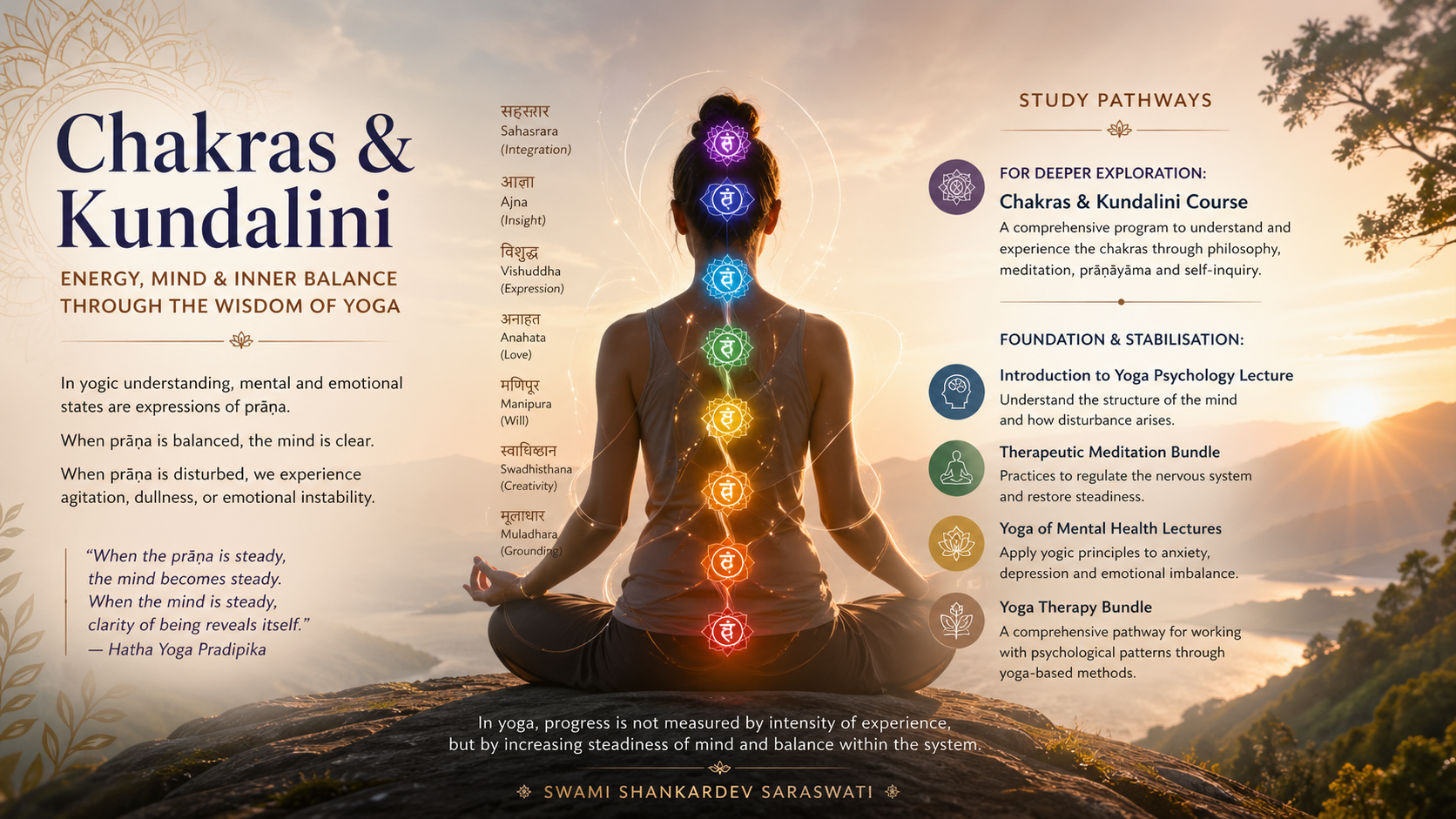
Study Pathways
For those who are already established in regular practice, and are seeking a deeper, structured exploration of the psyche and energy body:
🔗 Chakras & Kundalini Course
This program offers a comprehensive and progressive approach, moving from foundational philosophy into direct work with each chakra, including meditation, prāṇāyāma, and self-inquiry practices. It is designed to be undertaken over time, allowing both understanding and experience to develop together.
—
If your priority at present is stabilising the system, it is more appropriate to begin with foundational work:
🔗 Introduction to Yoga Psychology Lecture
A clear framework for understanding the structure of the mind and how disturbance arises.
🔗 Therapeutic Meditation Bundle
Practices that regulate the nervous system and gradually restore steadiness.
🔗 Yoga of Mental Health Lectures
Teachings that apply yogic principles directly to anxiety, depression, and emotional imbalance.
🔗 Yoga Therapy Bundle
A broader and more comprehensive pathway for working with psychological patterns through yoga-based methods.
—
There is no need to move ahead of where you are. In yoga, the path unfolds step by step. When the foundation is steady, the next stage reveals itself naturally.
📿 Swami Shankardev Saraswati

Comments